Peace Lily Care: Watering, Light, Flowers and Brown Tips
Peace lily care indoors: when to water, how much light it needs to flower, the right soil, repotting, and fixing brown tips, yellow leaves and drooping.

On this page
- Peace lily care at a glance
- Light: how much does a peace lily need?
- Watering a peace lily
- Soil and pots
- Feeding for flowers
- Why isn't my peace lily flowering?
- Peace lily brown tips and brown leaves
- Yellow leaves
- Drooping
- Peace lily care in water
- Peace lily care outdoors
- Pets and safety
- Sources and further reading
Peace lily care, in short: keep it in medium to bright, indirect light, water when the top 2–3 cm of soil are dry (it will droop to tell you if you're late), and grow it in a moisture-holding but free-draining mix in a pot with drainage. Feed lightly in spring and summer for more flowers, and wipe the big leaves now and then. The peace lily (Spathiphyllum) is one of the few houseplants that flowers reliably indoors.
Peace lily care at a glance
| Need | What works |
|---|---|
| Light | Medium to bright indirect. Tolerates low light but flowers less. |
| Water | When the top 2–3 cm are dry. Likes even moisture. |
| Soil | General potting mix with perlite, or a moisture-holding mix |
| Humidity | Average is fine. Enjoys higher humidity. |
| Temperature | Ideally 18–27 °C. Dislikes cold drafts below about 13 °C. |
| Feeding | Half-strength balanced feed every 4–6 weeks, spring–summer |
| Repotting | Every 1–2 years, or when root-bound |
| Pets | Toxic to cats and dogs (ASPCA) |
Light: how much does a peace lily need?
Peace lilies are understory plants, so they're happy out of direct sun. They grow well a metre or two from an east- or north-facing window, or further back in a bright south- or west-facing room.
- Low light: the plant survives and grows leaves, but rarely flowers.
- Medium to bright indirect light: best growth and regular flowering.
- Direct sun: bleached, yellow or scorched leaves.
Use our plant light meter converter to check. For flowers, aim for the "Medium light" band or better, roughly 250 foot-candles (about 2,700 lux) and up.
Watering a peace lily
Peace lilies are famous for their dramatic droop. When the soil dries out, the whole plant wilts, and then it perks up within hours of watering. That's handy, but don't use the droop as your routine: repeated collapses cause brown tips and yellow leaves.
Better rule: water when the top 2–3 cm of soil feel dry, before it droops. Water thoroughly, let it drain, and empty the saucer.
The watering schedule builder treats peace lily as a plant that likes to stay lightly moist, so its check intervals are short:
| Setup (plastic pot, spring–summer) | Check soil every |
|---|---|
| Medium light, 15 cm pot | 4 days |
| Low light, 15 cm pot | 6 days |
| Medium light, 25 cm pot | 5 days |
| Medium light, 15 cm pot, autumn–winter | 6 days |
These are check intervals. Many peace lilies only need water every week or so, but checking twice as often means you catch it before it collapses.
Water quality
Peace lilies are sensitive to salts and, according to many growers, fluoride and chlorine in tap water, which may show up as brown leaf tips. If your tap water is hard, use filtered water or rainwater, or at least flush the pot with plenty of water every couple of months to wash out salt build-up. Our how to water houseplants guide covers flushing and bottom watering.
Soil and pots
Use a good general potting mix with perlite for drainage. A moisture-holding mix also suits peace lilies. Our soil mix calculator has one: 60% potting soil, 25% coco coir and 15% perlite. For 3 litres, measure 1.8 L soil, 0.75 L coir and 0.45 L perlite.
Always use a pot with a drainage hole. Peace lilies like moisture, not waterlogging.
Repotting
Repot every 1–2 years in spring, or when roots circle the pot and the plant needs water every couple of days. Go up only 2–5 cm. From a 15 cm pot, our repotting pot size calculator suggests 19 cm. Large clumps can be divided into smaller plants at the same time, each with a few crowns and healthy roots. Our how to repot a houseplant guide explains the steps.
Feeding for flowers
Feed with a balanced liquid houseplant fertilizer at half strength every 4–6 weeks during spring and summer. Too much feed causes brown leaf tips and, oddly, can reduce flowering. With a 5 ml per litre label dose, the fertilizer dilution calculator gives 2.5 ml for 1 litre of water at half strength.
Why isn't my peace lily flowering?
- Not enough light. The most common reason. Move it closer to a window.
- Too young. Small plants may not bloom until they mature.
- Recently divided or repotted. It may skip a season while it re-establishes.
- Overfed with high-nitrogen fertilizer. Leaves at the expense of flowers.
- It's just resting. Peace lilies flower mainly in spring and summer, with breaks between.
Note that many shop-bought peace lilies were treated with a plant hormone to flower on time for sale. Don't worry if it takes a while to flower again at home.
What to do with old flowers
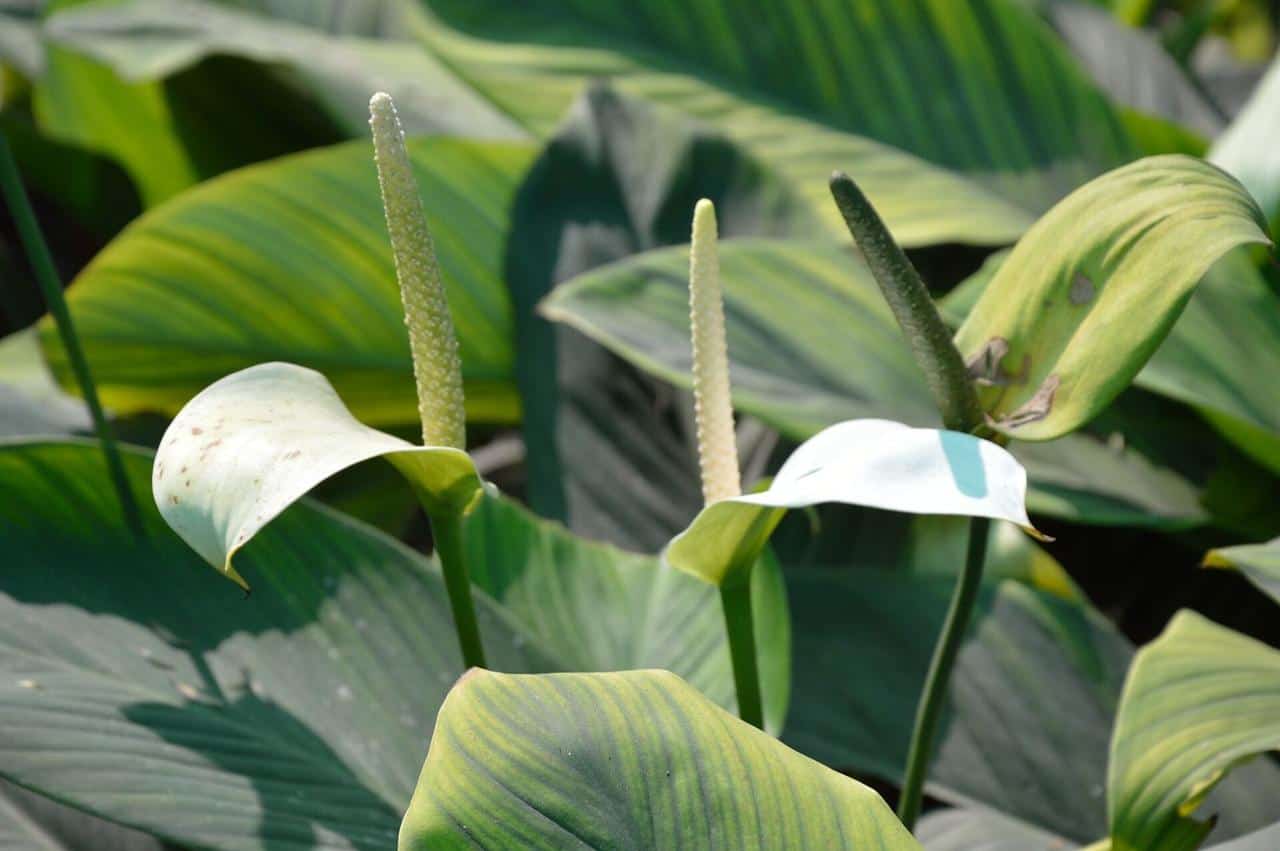
The white "flower" is a modified leaf called a spathe. As it ages, it turns green, then brown. Cut the whole flower stalk off at the base once it fades.
Peace lily brown tips and brown leaves
| Symptom | Likely cause | Fix |
|---|---|---|
| Brown, crispy leaf tips | Irregular watering, salts, dry air | Water evenly, flush soil, filtered water |
| Brown edges plus yellowing | Underwatering, repeated wilting | Check more often |
| Large brown patches | Direct sun scorch | Move away from the window |
| Brown, soft areas near the base | Overwatering, root rot | Let dry, check roots |
| Brown spots with yellow halos | Leaf spot disease, often from wet leaves | Remove leaves, water the soil, not the foliage |
You can trim brown tips with clean scissors, following the natural leaf shape. The trimmed leaf won't regrow the tip, but it will look tidier.
Yellow leaves
An occasional old leaf turning yellow is normal. Several leaves yellowing suggest overwatering, a pot without drainage, or, if the soil is dry, underwatering. A plant in the same soil for years may also be short of nutrients. Our guides to pothos yellow leaves and monstera yellow leaves cover the diagnosis in detail, and the same logic applies.
Drooping
- Dry soil: water it. It should recover within hours.
- Wet soil and drooping: root rot. The roots can't take up water. Check them.
- Just repotted: transplant shock. Keep it out of direct sun and wait.
- Cold drafts: move it away from doors, windows and air conditioning in winter.
Peace lily care in water
You may see peace lilies sold in a vase with a fish or with roots dangling in water. They survive like this for a while, but it's not a good long-term setup. If you have one, change the water often, keep the crown above the water line, and add a very dilute fertilizer. For a long-lived plant, move it to a pot of soil.
Peace lily care outdoors
In frost-free tropical climates, peace lilies grow outside in shade. Elsewhere, they're houseplants. They can spend summer outdoors in deep shade, sheltered from wind, but come in well before nights drop below about 13 °C.
Pets and safety
The ASPCA lists peace lily as toxic to cats and dogs. It contains calcium oxalate crystals that cause mouth pain, drooling and vomiting. It isn't a true lily, so it doesn't cause the kidney failure that Lilium species can cause in cats, but it's still best kept out of reach. For pet-safe alternatives, read low light plants safe for cats.
Peace lilies are a good fit for bright bathrooms, where they enjoy the humidity. See our bathroom plants guide.
Sources and further reading
- ASPCA Toxic and Non-Toxic Plants list, peace lily entry.
- Royal Horticultural Society, for Spathiphyllum care.
- University of Minnesota Extension, on growing flowering houseplants.
Frequently asked questions
How often should I water a peace lily?
When the top 2 to 3 cm of soil feel dry, or when the leaves just begin to droop. In medium light during spring and summer, that's often about once a week. Peace lilies prefer evenly moist soil but rot if they sit in water.
Why does my peace lily have brown tips?
Common causes are irregular watering, letting the plant dry out until it collapses, dry air, and salts or fluoride from tap water and fertilizer. Water more evenly, flush the soil occasionally and use filtered or rain water if your tap water is hard.
Why is my peace lily not flowering?
Usually not enough light. Peace lilies survive in low light but flower best in bright, indirect light. Young plants and plants that have just been divided may also take time to flower.
Can peace lilies live in water?
Peace lilies are sometimes sold growing in vases with roots in water. They can survive like this for a while, but they grow better and live longer in a potting mix with drainage.
Is a peace lily toxic to cats?
Yes, the ASPCA lists peace lily as toxic to cats and dogs because of calcium oxalate crystals, which irritate the mouth and stomach. It is not a true lily, so it doesn't carry the kidney risk that Lilium species do, but it should still be kept away from pets.