Spider Plant Care: Light, Water, Babies and Brown Tips
Spider plant care indoors: light, watering, soil, feeding, why tips turn brown, how to prune it, and how to root spider plant babies in water or soil.

On this page
Spider plant care, in short: give it bright to medium indirect light, water when the top few centimetres of soil are dry, use a general potting mix in a pot with drainage, and feed lightly in spring and summer. A happy spider plant (Chlorophytum comosum) grows quickly and sends out long stems of baby plants, which root easily. It's non-toxic to cats and dogs, which makes it one of the best beginner plants for pet owners.
Spider plant care at a glance
| Need | What works |
|---|---|
| Light | Bright to medium indirect. Some gentle sun is fine. |
| Water | When the top 2–5 cm are dry |
| Soil | General potting mix with perlite |
| Humidity | Average home humidity |
| Temperature | Ideally 15–27 °C. Keep above about 7–10 °C. |
| Feeding | Half-strength feed monthly in spring–summer |
| Repotting | When roots push up out of the soil, usually every 1–2 years |
| Pets | Non-toxic to cats and dogs (ASPCA) |
Spider plant varieties
| Variety | Look | Note |
|---|---|---|
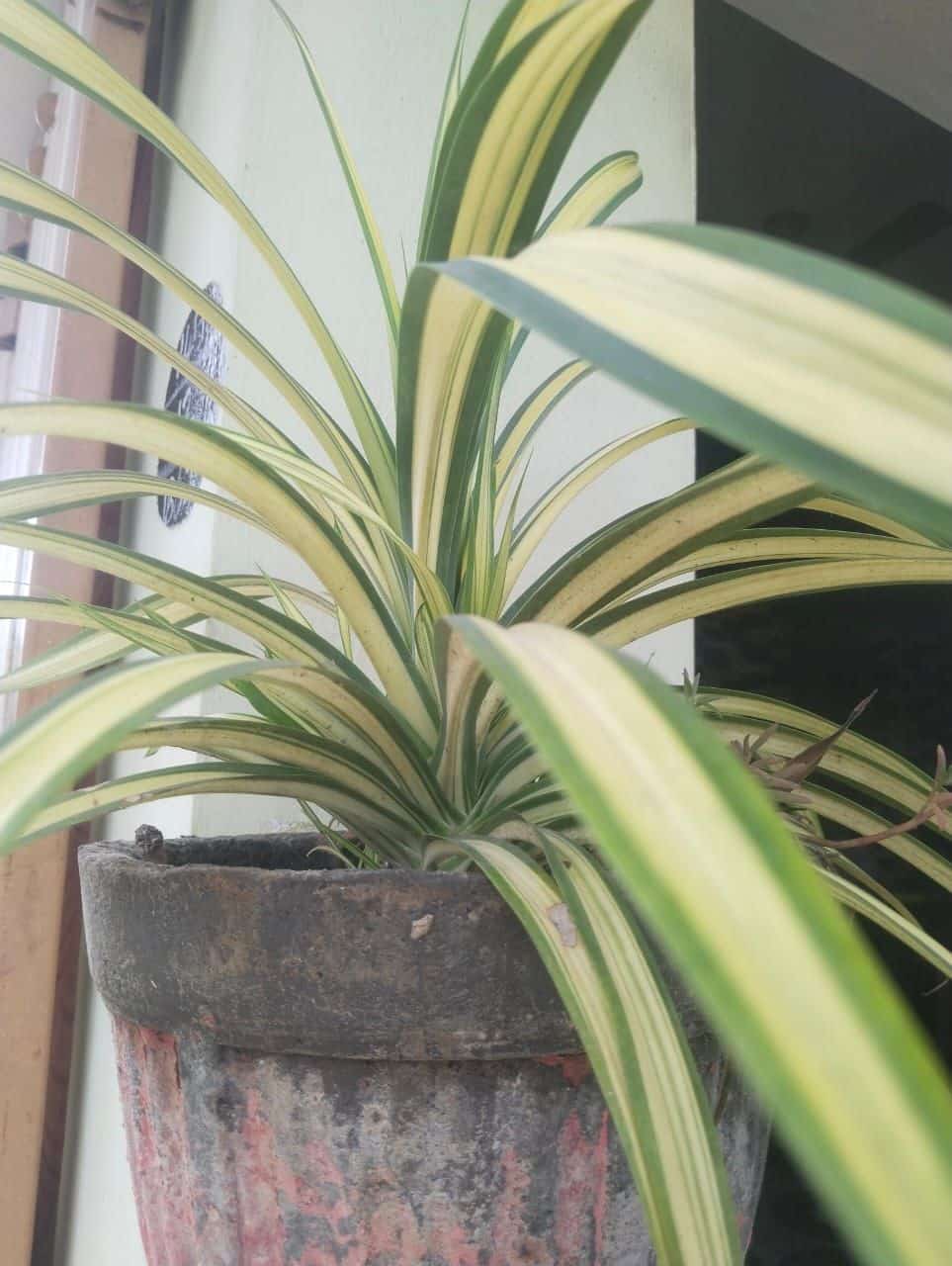
| 'Vittatum' | Green edges, white central stripe | The classic, very common |
| 'Variegatum' | White or cream edges, green centre | Similar care, slightly more light |
| 'Bonnie' | Curly, twisting leaves | Compact, great in hanging pots |
| Plain green | Solid green leaves | Copes with lower light best |
| 'Ocean' | Narrow, cream-edged, compact | Fewer, shorter runners |
All of these share the same care. Variegated types need a little more light to keep strong stripes, because the white parts of the leaf don't photosynthesise.
Light
Spider plants grow best in bright, indirect light, such as near an east-facing window or a metre or two back from a south- or west-facing one. They tolerate medium light well and survive lower light, but:
- In low light, growth slows, leaves get floppier, and variegated types lose some white or cream stripe.
- Very hot direct sun can scorch leaves and cause brown patches.
Our low-light plant finder lists spider plant under "Medium" and "Bright" light, not "Low". It's not a dark-corner plant. If you want something non-toxic for a darker spot, see low light plants safe for cats.
Watering
Water when the top 2–5 cm of soil are dry. Spider plants have thick, fleshy roots that store water, so they handle a missed watering better than overwatering.
The watering schedule builder suggests these starting check intervals:
| Setup | Check soil every |
|---|---|
| Medium light, 15 cm plastic pot, spring–summer | 7 days |
| Bright light, 15 cm plastic pot, spring–summer | 6 days |
| Medium light, 12 cm hanging pot, spring–summer | 6 days |
| Bright light, 12 cm terracotta pot, spring–summer | 4 days |
| Medium light, 15 cm plastic pot, autumn–winter | 11 days |
Hanging baskets near the ceiling dry faster because warm air rises. Check them more often in summer, and take them down to water so the run-off drains into a sink rather than onto the floor.
Spider plant care in water
Spider plant babies root easily in water and can live there for a while. For a long-lived plant, move rooted babies into soil once roots are a few centimetres long. If you keep them in water, change it weekly and add a very weak fertilizer monthly.
Soil and pots
A general houseplant mix works well. Our soil mix calculator has a simple recipe: 70% potting soil and 30% perlite. For a 2 litre pot, that's 1.4 L soil and 0.6 L perlite. Our houseplant soil mix guide explains when to use other mixes.
Spider plants grow fast and their thick roots fill a pot quickly. Signs it's time to repot: roots pushing up above the soil, roots out of the drainage hole, a plastic pot bulging, or the plant needing water every couple of days. Go up 2–5 cm. From a 12 cm pot, the repotting pot size calculator suggests 14.5 cm. A slightly snug pot encourages more babies.
Feeding
Feed with a balanced liquid houseplant fertilizer at half strength once a month in spring and summer. Spider plants are sensitive to fertilizer salts, which cause brown tips, so err on the weaker side. Our fertilizer dilution calculator gives the dose: a 5 ml per litre label at quarter strength in 2 litres is 2.5 ml.
Spider plant brown tips
Brown tips are the most common spider plant complaint. Causes, from most to least likely:
- Fluoride, chlorine and salts in tap water. Spider plants are known to be sensitive to fluoride. Use rainwater or filtered water if your tap water causes problems.
- Fertilizer salts. Flush the soil every couple of months by running water through it for a minute, and feed less.
- Irregular watering. Letting it dry out completely, then soaking it, stresses the leaf tips.
- Dry air. Near radiators in winter, tips crisp more.
- Cold damage. Leaves touching cold glass.
Trim brown tips with clean scissors, cutting at an angle to follow the leaf's natural point. The leaf won't regrow the tip, but trimmed leaves look fine.
Spider plant babies (plantlets)
Mature, slightly pot-bound spider plants in good light send out long stems that carry small white flowers and then baby plants. To propagate:
| Method | How | Time to roots |
|---|---|---|
| Water | Cut off a baby with root nubs and stand its base in water | 1–2 weeks |
| Soil, attached | Rest the baby on a small pot of mix next to the parent, keep moist, cut the runner once rooted | 2–3 weeks |
| Soil, detached | Plant a baby with root nubs into moist mix and keep it humid | 2–4 weeks |
Plant several babies in one pot for a fuller plant quickly.
Why isn't my spider plant producing babies?
- It's too young. Plants usually need to mature first.
- Too little light.
- The pot is too big. A bit of crowding helps.
- It's the wrong time of year. Runners often follow longer days in spring and summer.
Pruning a spider plant
- Cut off brown or yellow leaves at the base.
- Cut off runners if you want the parent to put energy into its own leaves.
- Trim brown tips as needed.
- Thin out very crowded plants when repotting by dividing them.
Common problems
| Problem | Likely cause | Fix |
|---|---|---|
| Brown tips | Water quality, salts, irregular watering | See above |
| Pale, washed-out leaves | Too much direct sun, or too little light | Adjust position |
| Yellow, mushy base | Overwatering, root rot | Let dry, check roots |
| Limp, folded leaves | Underwatering | Soak the pot |
| Sticky leaves, small insects | Aphids, mealybugs or scale | Wipe and treat |
| Fine webbing, speckles | Spider mites | Wipe leaves, raise humidity, treat |
Spider plant care outside
Spider plants can spend summer outdoors in a shaded or partly shaded spot, in hanging baskets or containers. Bring them in before nights get cold. They're not frost hardy. In warm, frost-free climates, they're grown as ground cover.
Are spider plants good for cats and families?
Spider plants are on the ASPCA's list of plants non-toxic to cats and dogs, and they're commonly recommended for homes with pets and children. Cats are often drawn to the arching leaves. Chewing isn't poisonous, but eating a lot can cause mild vomiting, so hang it if your cat is a determined chewer. Spider plants are also a good choice for brighter bathroom plants.
Spider plant care checklist
- Bright to medium indirect light
- Water when the top few cm are dry
- General potting mix with perlite and drainage
- Half-strength feed monthly in spring and summer
- Use rain or filtered water if tips brown
- Repot when roots push out of the soil
- Root the babies and share them
Sources and further reading
- ASPCA Toxic and Non-Toxic Plants list, spider plant entry (non-toxic).
- Royal Horticultural Society, Chlorophytum comosum care.
- University of Minnesota Extension, on houseplant leaf tip burn and water quality.
Frequently asked questions
How often should I water a spider plant?
When the top 2 to 5 cm of soil are dry, which is often about once a week in spring and summer in medium light, and less in winter. Spider plants store water in thick roots, so they forgive the odd missed watering.
Why does my spider plant have brown tips?
Brown tips are very common on spider plants. Usual causes are fluoride and salts in tap water, fertilizer build-up, irregular watering and dry air. Use filtered or rain water, flush the soil occasionally, and water more evenly.
Are spider plants safe for cats?
Yes. The ASPCA lists spider plant (Chlorophytum comosum) as non-toxic to cats and dogs. Cats often love chewing the leaves, which can cause mild stomach upset, so a hanging basket is still a good idea.
Can spider plants live in low light?
They survive in lower light but grow slowly, lose some stripe contrast and produce fewer babies. Medium to bright, indirect light is best.
When should I cut off spider plant babies?
Once the plantlets have small roots forming at their base, usually when they're a few centimetres across. You can also root them while still attached by resting them on a pot of soil.