Monstera Deliciosa Care for Beginners: Your First Year
Monstera deliciosa care for beginners: a first-year plan from bringing it home to the first repot, moss pole and split leaves and a printable care sheet.

On this page
- Monstera deliciosa care sheet
- Is it really a monstera deliciosa?
- Week 1: bringing your monstera home
- Months 1–3: getting the watering right
- Months 2–6: light and growth
- Spring: the first repot
- Spring to summer: feeding
- When it starts to sprawl: adding a moss pole
- Autumn and winter: slowing down
- Split leaves: when do fenestrations start?
- Monstera deliciosa care outdoors and in the UK
- Monstera deliciosa in water
- Your first-year checklist
- Sources and further reading
Monstera deliciosa care, in one paragraph: put your plant in bright, indirect light within a couple of metres of a window, water it when the top 3 to 5 cm of soil are dry, and grow it in a chunky, free-draining mix in a pot with a drainage hole. Feed lightly from spring to late summer, give it a moss pole once it starts to sprawl, and repot every one to two years. That's genuinely all most monsteras need.
This guide follows a new plant through its first year, step by step. If you want the full reference on light, water, soil and problems, our monstera care guide covers each topic in depth.
Monstera deliciosa care sheet
| Need | What to do |
|---|---|
| Light | Bright, indirect. Some gentle morning sun is fine. |
| Water | When the top 3–5 cm of soil are dry |
| Soil | Chunky aroid mix: soil, orchid bark, perlite, charcoal |
| Pot | Drainage hole, 2–5 cm wider at each repot |
| Humidity | Average home humidity is fine |
| Temperature | Ideally 18–27 °C. Keep above about 12 °C. |
| Feeding | Half-strength liquid feed every 2–4 weeks, spring to late summer |
| Support | Moss pole or stake once stems lean |
| Pets | Toxic to cats and dogs (ASPCA) |
Want this on the fridge? The plant care card tool prints a one-page card for monstera and 21 other plants.
Is it really a monstera deliciosa?
Before you start, check what you have. Shops label several plants "monstera":
| Plant | Leaves | Growth |
|---|---|---|
| Monstera deliciosa | Large, heart-shaped, splits and holes with age. Leaf stalk has a wavy, ruffled "knee" where it meets the leaf. | Big, climbing, grows wide |
| Monstera deliciosa 'Borsigiana' (as sold) | Similar, often smaller, without the ruffled knee | Faster, longer gaps between leaves |
| Monstera adansonii | Smaller leaves full of oval holes, no edge splits | Vining, good for hanging pots |
| Rhaphidophora tetrasperma ("mini monstera") | Small leaves with splits | Fast climber, not a true monstera |
Care is similar for all of them, but adansonii and tetrasperma stay much smaller and prefer slightly more humidity.
Week 1: bringing your monstera home
Plants are grown in bright greenhouses, so a home is a shock. Expect a leaf to yellow or droop in the first few weeks. That's normal.
- Choose the spot first. East- or west-facing windows are ideal, or a south-facing room set back from the glass. In north-facing rooms, put it right by the window.
- Check the pot. Many plants come in a plastic nursery pot inside a decorative one. That's fine, as long as you empty any water that collects in the outer pot.
- Don't repot yet. Let it settle for a few weeks unless the roots are bursting out or the soil is waterlogged.
- Check for pests. Look under leaves and where leaves meet stems for webbing, sticky spots or small bumps.
- Don't water by default. Feel the soil. Nursery soil is often moist already.
Months 1–3: getting the watering right
Watering is where most beginners struggle. Monsteras like a good drink, then a chance to dry partly. Our watering schedule builder gives starting check intervals for a monstera in a plastic pot:
| Setup | Check soil every |
|---|---|
| Medium/bright indirect light, 20 cm pot, spring–summer | 7 days |
| Bright light with some sun, 20 cm pot, spring–summer | 6 days |
| Medium light, 25 cm pot, spring–summer | 8 days |
| Medium light, 25 cm pot, autumn–winter | 13 days |
When it's time, water slowly until it runs out of the drainage hole, let it drain, and empty the saucer. Our guide to watering houseplants covers the finger test and bottom watering.
Is it thirsty or overwatered? Thirsty monsteras droop slightly and leaves may curl inwards. Overwatered ones get yellow leaves, often the lower ones first, and soil that stays damp for more than a week. If you're seeing yellow leaves, read our monstera yellow leaves troubleshooter.
Months 2–6: light and growth
A healthy monstera in good light produces a new leaf every few weeks in spring and summer. Each new leaf emerges from a sheath on the previous leaf's stalk, unfurls over a few days, and darkens and hardens over a couple of weeks.
If new leaves are small, solid and on long stems, the plant wants more light. Check your spot with our light meter converter. Monsteras grow best in the "Medium light" to "Bright indirect" range: roughly 250 to 1,000+ foot-candles. A grow light is a good fix for dark rooms. See grow lights for houseplants.
Rotate the pot a quarter turn every couple of weeks, or the plant will lean towards the window.
Spring: the first repot
Most nursery monsteras need repotting within the first year. Signs: roots coming out of the drainage hole, roots circling the pot, or water running straight through.
- Choose a pot 2–5 cm wider. Our repotting pot size calculator suggests the next size up. From a 20 cm pot, it suggests 24 cm (range 22–25 cm). From 25 cm, it suggests 30 cm.
- Mix a chunky aroid soil. The soil mix calculator scales the recipe: 5 litres is 2 L potting soil, 1.5 L orchid bark, 1 L perlite and 0.5 L charcoal.
- Water a day before, so the root ball slides out easily.
- Loosen circling roots gently, set the plant at the same depth, and fill around it.
- Water well, and keep it out of strong sun for a week or two.
Our step-by-step guide to how to repot a houseplant walks through each stage, including large plants. For the mix itself, see houseplant soil mix.
Spring to summer: feeding
Use a balanced liquid houseplant fertilizer at half strength every 2–4 weeks while it's growing. If the label says 5 ml per litre, our fertilizer dilution calculator shows that a 2 litre can at half strength needs 5 ml (about 1 teaspoon). Stop in autumn and winter, when growth slows.
When it starts to sprawl: adding a moss pole
In the wild, monsteras climb trees. Indoors, a young plant grows upright for a while, then stems start to lean and the plant spreads sideways. A support makes it neater and, many growers find, encourages bigger leaves.
- Choose a moss pole, coir pole or sturdy stake, a little taller than the plant.
- Push it into the pot on the side the stems lean towards, avoiding the main roots. It's easiest when repotting.
- Tie stems loosely to the pole with soft plant ties or Velcro.
- Point the aerial roots towards the pole. If it's a moss pole, keep the moss slightly damp so roots grow into it.
Autumn and winter: slowing down
As days shorten, monsteras slow down. Water less often (the 25 cm pot above moves from about 8 to about 13 days between checks), stop feeding, and keep the plant away from cold windows and radiators. Leaves may still appear, just more slowly. Don't repot in winter unless it's an emergency.
Split leaves: when do fenestrations start?
Young monsteras have solid, heart-shaped leaves. As the plant matures and gets enough light, new leaves develop slits from the edge and later holes (fenestrations). There's no fixed age. Light is usually the deciding factor. A mature plant that keeps producing solid leaves is almost always short of light.
Monstera deliciosa care outdoors and in the UK
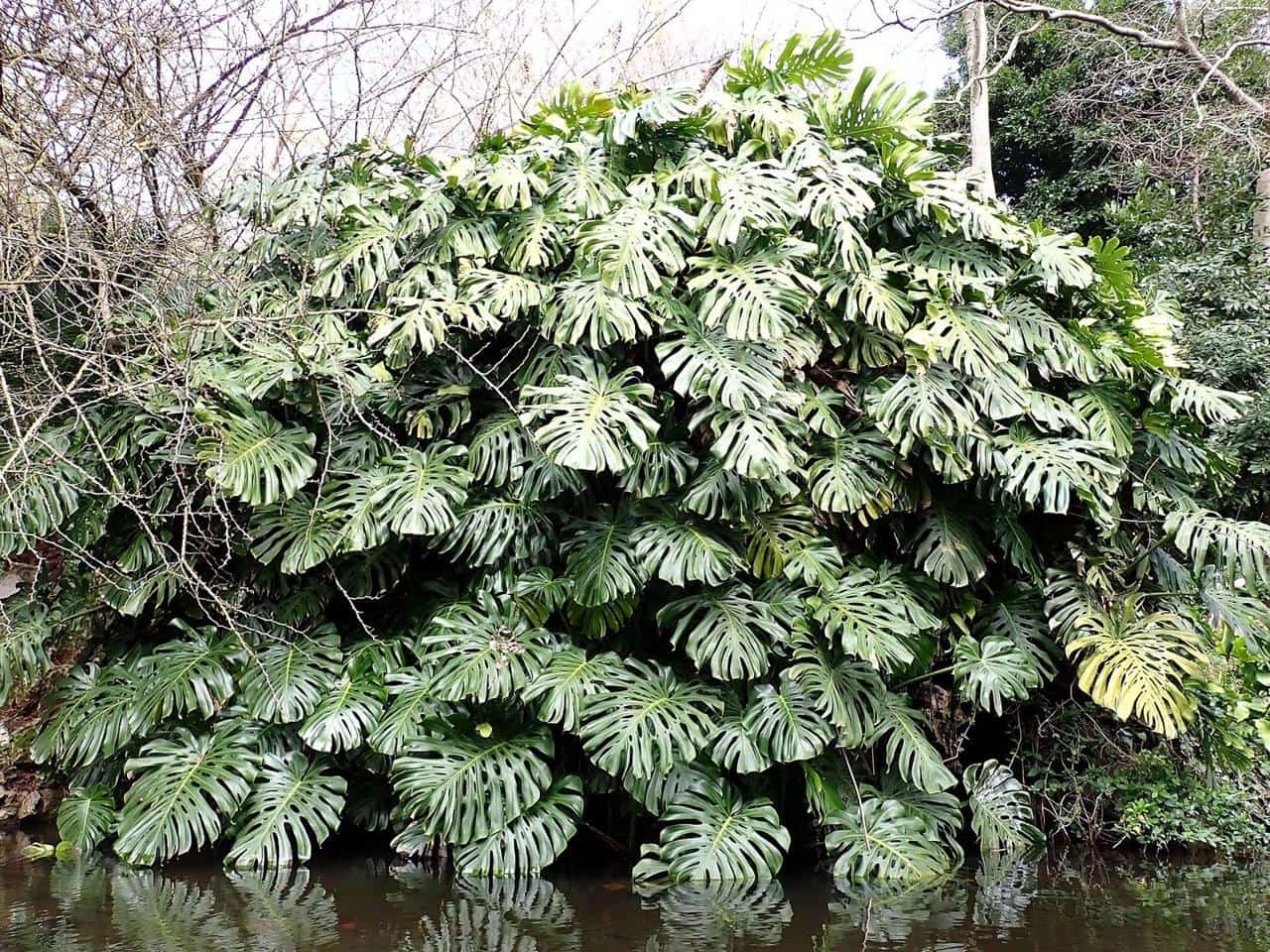
In warm, frost-free climates, monsteras grow outside in shade and can get huge. In the UK and similar climates, treat monstera as a houseplant. Monstera is not frost hardy, so it needs protection from cold. It can spend summer outside in a sheltered, shaded spot if nights stay mild, but bring it in well before temperatures drop below about 12 °C.
Monstera deliciosa in water
Monstera cuttings root readily in water. Cut below a node (the bump where leaves and aerial roots grow), stand it in water so the node is submerged, and change the water weekly. Roots appear in a few weeks. You can keep it in water for months, adding a very dilute fertilizer occasionally, but it will grow more strongly once moved into soil.
Your first-year checklist
- Bright, indirect spot within a couple of metres of a window
- Pot with a drainage hole, saucer emptied after watering
- Soil checked every 6–8 days in summer, 12–14 days in winter
- Half-strength feed every 2–4 weeks in spring and summer
- Repotted once into a pot 2–5 cm wider, in chunky aroid mix
- Moss pole added when stems start to lean
- Leaves wiped and plant rotated monthly
- Kept out of reach of pets that chew plants
Sources and further reading
- ASPCA Toxic and Non-Toxic Plants list, which lists Monstera deliciosa (as split-leaf philodendron) as toxic to cats and dogs.
- Royal Horticultural Society, for monstera cultivation and hardiness.
- Missouri Botanical Garden Plant Finder, for species information.
Frequently asked questions
Is monstera deliciosa easy to care for?
Yes. It's one of the more forgiving large houseplants. Give it bright, indirect light, water when the top few centimetres of soil are dry, use a chunky free-draining mix and a pot with drainage, and it will grow steadily.
How do I know if my plant is a monstera deliciosa?
Monstera deliciosa has large, heart-shaped leaves that develop splits and holes as the plant matures, and ruffled, wavy leaf stalks where they join the leaf. Plants sold as 'mini monstera' are usually Rhaphidophora tetrasperma, which is a different plant with much smaller leaves.
Can monstera deliciosa live outdoors?
In frost-free, warm climates it grows outdoors in shade or dappled light. In cooler climates, such as most of the UK and northern US, keep it indoors. It can go outside in a sheltered, shaded spot in summer if nights stay above roughly 12 to 15 °C.
Can I grow monstera deliciosa in water?
Cuttings root well in water and can stay there for months. For long-term growth into a large plant, move it into a free-draining potting mix once roots are a few centimetres long.
When will my monstera get split leaves?
Young monsteras produce solid leaves. Splits usually start once the plant is a bit older and gets enough light, often after a few leaves on a healthy plant. Too little light is the most common reason a mature plant produces solid leaves.