
Marathon fueling
Coffee Before a Marathon on a Plant-Based Diet: Timing and Dosing
Caffeine still works if you are vegan: 3–6 mg/kg, 45–60 minutes pre-gun. Count the gels, skip the oat-milk mocha, and do not quit coffee in taper week.
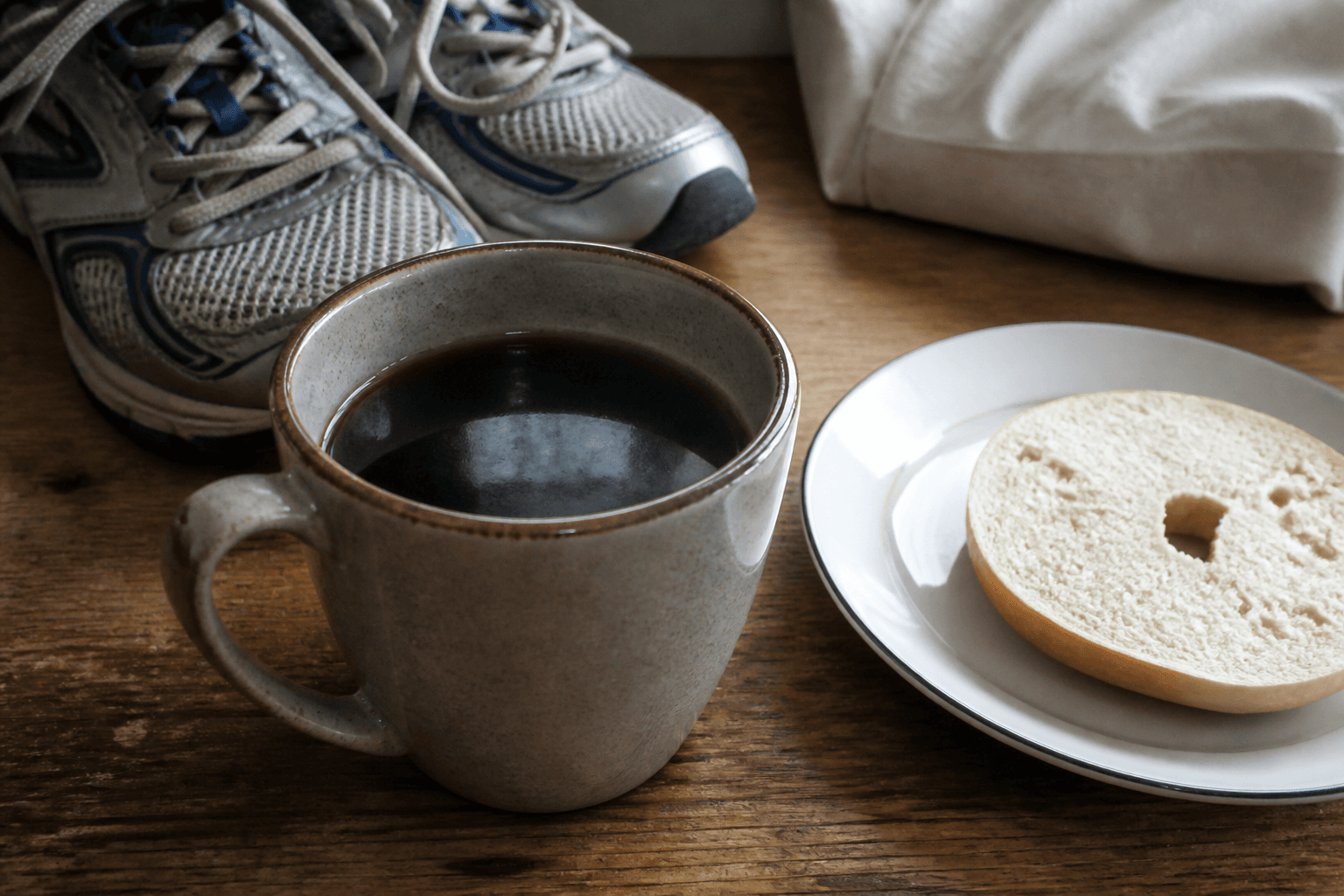
Caffeine still works on a plant-based diet at about 3–6 mg per kg of body mass, taken 45–60 minutes before the gun. The ISSN 2021 position stand is the dose map; being vegan does not change CYP1A2 or adenosine receptors. What does change is the vehicle: an oat-milk mocha can spend fiber and fluid you did not budget, and a Maurten Gel 100 Caf 100 is 100 mg you must add to the coffee rather than treat as free.
Dose it in milligrams. Time it. If coffee empties your bowel on long-run mornings, use a practised caffeinated gel instead of "one more cup for luck."
Dose is milligrams, not cups
Guest and colleagues (ISSN, 2021) land on ~3–6 mg/kg. Performance benefits flatten toward the top of that range while anxiety, tachycardia, and bowel urgency keep climbing. Most marathoners should live near 3 mg/kg unless they have raced the higher end in training.
| Body mass | ~3 mg/kg | ~6 mg/kg | Practical note |
|---|---|---|---|
| 55 kg | ~165 mg | ~330 mg | One strong coffee may be the whole dose |
| 60 kg | ~180 mg | ~360 mg | A 100 mg gel later is easy to stack |
| 70 kg | ~210 mg | ~420 mg | Default planning number on this page |
| 80 kg | ~240 mg | ~480 mg | Stay inside what long runs already used |
"A coffee" is not a dose. The spread between preparations is wide enough to move a 70 kg runner from under-dosed to shaky without changing the number of cups.
| Source | Typical caffeine | Volume / notes |
|---|---|---|
| Single espresso | ~65 mg | Small volume, easier to time |
| Double espresso | ~130 mg | Still a small cup |
| Drip coffee, 350 ml | ~165 mg | Brew strength varies a lot |
| Cold brew, 350 ml | ~200 mg or more | Concentrate is the usual overshoot |
| Instant, 1 tsp | ~60 mg | Hotel-friendly if that is your rehearsal drink |
| Maurten Gel 100 Caf 100 | 100 mg | 25 g carbohydrate as well |
| Neversecond C30 Caffeine Gel | 75 mg | 30 g carbohydrate |
| Precision PF 30 Caffeine Gel | 100 mg | Sodium is in their drink line, not the gel |
| Tailwind Endurance Fuel, caffeinated | ~35 mg per labeled serving | Also ~25 g carbohydrate, ~310 mg sodium |
| GU Roctane (many flavors) | ~35 mg | Vegan status is unclear on amino-acid sourcing — do not assume the whole GU wall is equivalent |
Check caffeine on the packet you actually carry. Flavor lines change. The gels and chews catalog is for vegan status; the panel is for milligrams.
Plan 3 mg/kg unless you have raced higher. Add coffee and every caffeinated packet into one total. Cold brew is how people accidentally double it.
Timing, and whether to split the dose
Plasma caffeine typically peaks around 45–60 minutes after ingestion. That is why the cup belongs after breakfast is down, not in the 4 a.m. hotel-room dark ninety minutes before you eat.
Two patterns both work if they are rehearsed:
- All up front. Coffee or espresso to ~3 mg/kg, 45–60 minutes pre-gun, non-caffeinated gels through the race (Maurten Gel 100, Neversecond C30, Tailwind uncaffeinated).
- Split. A smaller coffee (~1.5–2 mg/kg) plus a 75–100 mg gel in the second half, when the fatigue-blunting effect is more useful.
What does not work is discovering the second pattern at 32 km because someone handed you a caffeinated flavor. Hands shaking in the last 8 km is a dosing error, not "plant-based energy being weaker." Caffeine is caffeine.
Half-life is often around five hours, with wide individual spread. A 5:30 a.m. cup and a 10:00 a.m. 100 mg gel are still additive. Late-day races need the same arithmetic relative to the gun, not relative to sunrise.
Take the planned milligrams 45–60 minutes pre-start, or split with a practised late gel. Do not improvise a second caffeine source because the aid station had a different flavor.
Coffee versus a caffeinated gel
The molecule is the same. The gut experience is not.
Coffee is a larger fluid volume, often acidic, and for many people a reliable colonic stimulus. de Oliveira et al. (2014) list caffeine among nutritional factors in exercise GI complaints. Costa et al. (2017) put motility and splanchnic hypoperfusion in the same syndrome. If long-run mornings already include an urgent bathroom stop after the cup, race morning is a bad time to "see if today is different."
A caffeinated gel you have trained with delivers 75–100 mg in a few swallows plus 25–30 g of carbohydrate. Take it with water, the same as any other gel. That is a gut decision.
If you tolerate coffee, keep it. Familiarity beats a new delivery system on race morning. Switch vehicles in a long run first.
Match the rest of the morning to breakfast timing: food 2–4 hours out, caffeine later in that window so you are not drinking a large cup on a full stomach at the corral.
If coffee means a porta-potty, use a tested caffeinated gel. If coffee is your calm ritual and your gut is quiet, keep the ritual and still count the milligrams.
Plant-milk and fiber mistakes
Caffeine does not care that you are vegan. The menu around the cup does.
| Before (common race-morning order) | After (same caffeine job) |
|---|---|
| Oat-milk extra-large mocha, cocoa, whipped topping substitute | Double espresso or drip, splash of fortified soy if wanted |
| Cold-brew concentrate "the same size as usual" | The brew strength you used in long runs, milligrams estimated in advance |
| Chia latte or fiber-fortified oat drink | Plain coffee; chia stays out of race week |
| Coffee plus two 100 mg gels because "plant energy is weaker" | Coffee to ~3 mg/kg; one caffeinated gel only if that split was trained |
Oat drinks vary. Some are thin and low-fiber. Some are thick, added-fiber, and 300 ml in a paper cup you did not count. Fortified soy is the default splash: about 1 g of fiber per cup if you actually drink a cup, which you should not. A splash is tablespoons.
Cocoa in a mocha adds volume, fat, and sometimes fiber. Sugar is fine — carbohydrate is the point of race morning — but the drink should not become a second breakfast on top of a bagel.
Hotel coffee is a dosing unknown. Instant, measured, from the same jar you used in training is more reproducible than the lobby urn.
The cup is a milligram dose plus a little fluid. Oat-mocha theater, chia, and "plant energy is weaker" stacking are how a legal aid becomes a GI problem.
GI honesty, and what too much feels like
Caffeine increases colonic motor activity. Combined with race-morning nerves and a taper gut that has less bulk than usual, some runners will need a bathroom after any coffee. Plan time for that. A 60-minute pre-gun cup in a hotel with one toilet and three roommates needs a wider window than the physiology table implies.
Signs the dose is too high, from ISSN-type adverse-effect lists and from the start corral:
- Resting heart rate that feels wrong
- Jitteriness or a sense of anxiety that is not ordinary race nerves
- Repeated bathroom trips
- A late crash some runners report after a huge early dose
If any of that showed up in a long-run rehearsal, cut milligrams. Adrenaline will not cover it.
Caffeine is listed among GI aggravators for a reason (de Oliveira et al., 2014). It is still worth using for most runners. The honest version is a practised dose, not a third espresso because the forecast is warm.
Warm-weather races change fluid more than they change caffeine. Keep the milligrams stable; adjust drinking using the electrolyte drink mix guide and a plan you already ran in heat.
Urgency after coffee is a motility effect. Too much caffeine feels like jitters, extra bathroom stops, and a shaky last 10 km — cut the milligrams in training, not at the expo.
Do not quit caffeine in taper week
A withdrawal week is still passed around as a trick. ISSN 2021 does not require abstinence for an ergogenic effect; habitual users still respond. What withdrawal does produce, reliably, is headache, low mood, and constipation or the opposite, at the week you are trying to sleep.
Keep the daily habit through taper. Race morning is then a timed, counted version of a drink your gut already knows — aligned with the rest of a low-fiber breakfast, not a new stimulant experiment.
Put the milligrams into the same sheet as gels and drink mix. If the race plan is drink-mix heavy (Tailwind, Maurten Drink Mix 160, Neversecond C30 drink), remember some flavors are caffeinated and some are not.
Keep habitual caffeine through taper. Time 3 mg/kg (or your trained split) 45–60 minutes pre-gun, and write the gel milligrams down so they cannot surprise you.
Frequently asked questions
How much caffeine should I take before a marathon?
When should I drink coffee before a race?
Does coffee cause GI problems in runners?
Does caffeine work differently on a plant-based diet?
Should I quit caffeine before a marathon to boost the effect?
Which plant milk should I use in pre-race coffee?
How do I count caffeinated gels with my coffee?
Is espresso better than drip coffee before a race?
Sources
- Guest, N. S., et al. (2021). International Society of Sports Nutrition position stand: caffeine and exercise performance. Journal of the International Society of Sports Nutrition.
- de Oliveira, E. P., Burini, R. C., & Jeukendrup, A. (2014). Gastrointestinal complaints during exercise. Sports Medicine.
- Costa, R. J. S., et al. (2017). Systematic review: exercise-induced gastrointestinal syndrome. Alimentary Pharmacology & Therapeutics.
- Thomas, D. T., Erdman, K. A., & Burke, L. M. (2016). ACSM Joint Position Statement: Nutrition and Athletic Performance.
Educational content only. Carbohydrate, fiber, iron, B12, and hydration needs vary. Consult a sports dietitian or physician for individualized guidance — especially if you have a GI condition, anemia, or a history of underfueling.