
Marathon fueling
Plant-Based Marathon Breakfast Timing: 2, 3, and 4 Hours Before the Start
Eat 1–4 g/kg of low-fiber carbs 2–4 hours before the gun. Bagel and maple at 3 hours; juice or drink mix at 2 hours. No oats, no new food.
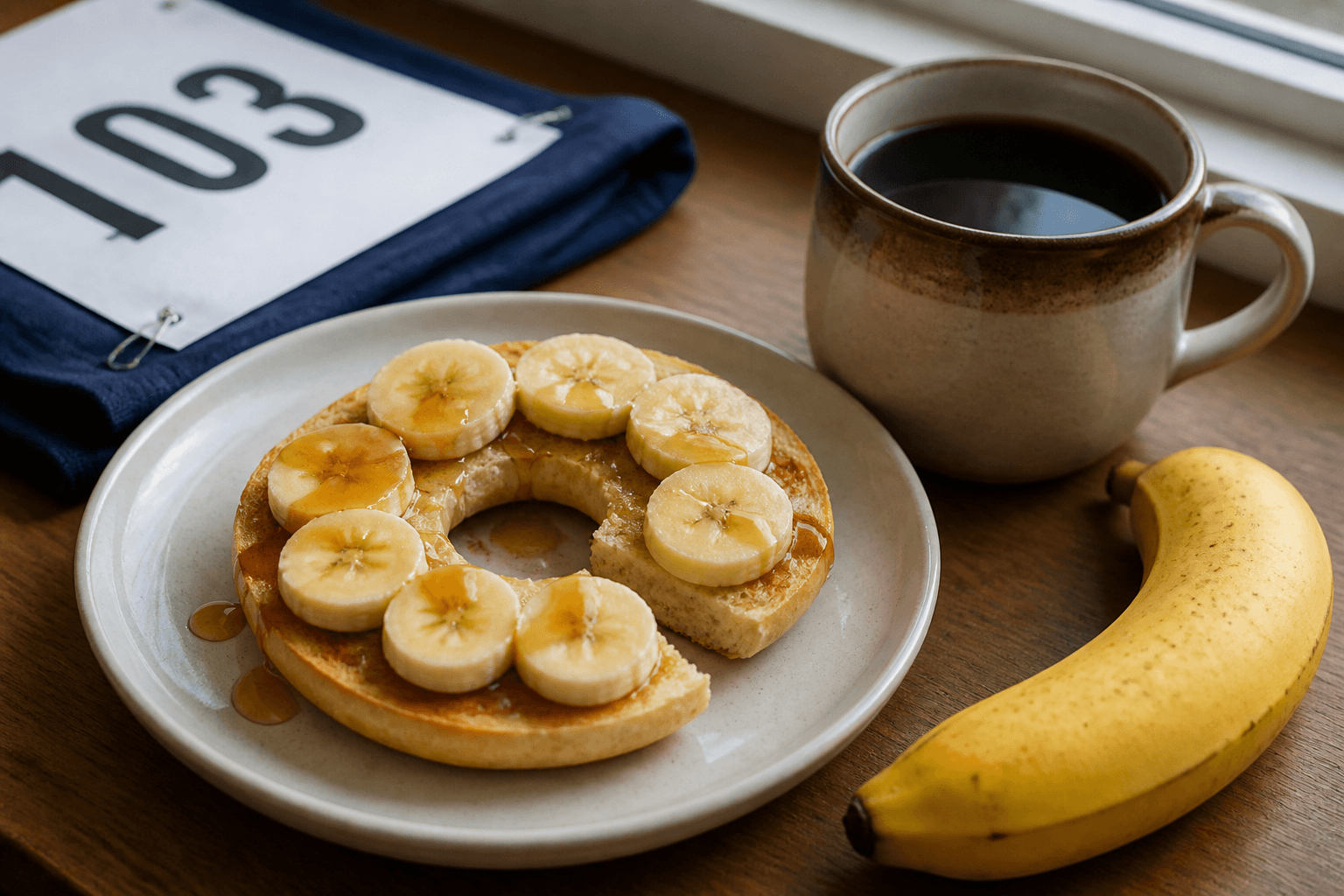
Eat 1–4 g of carbohydrate per kg in the 1–4 hours before the gun, using low-residue food you have already run on. A 70 kg runner three hours out usually lands near 110–175 g from a white bagel, maple, banana, and maybe juice — not from oats, chia, and berries.
The clock runs backward from the start, not forward from waking. A 7:00 a.m. gun with a 5:30 shuttle means breakfast around 4:15–4:30. That is a 2.5–3 hour window, not a 4-hour hotel sit-down. Scale the plate to the hours you actually have. If the shuttle is earlier than you like, the meal gets smaller and more liquid, not skipped.
How much carbohydrate, and how far out?
Burke et al. (2011) and ACSM 2016 describe about 1–4 g/kg in the 1–4 hours before prolonged exercise. The range is wide because guts and start times differ.
Practical translation for plant-based marathoners:
- More hours → you can chew more, still low fiber.
- Fewer hours → smaller, more liquid, faster emptying.
- Fiber, fat, and protein all slow gastric emptying. Race morning is a carbohydrate meal. Tofu can wait until after.
Most runners do not need the 4 g/kg top end on race morning if the carb load was done. Muscle glycogen is already high. Breakfast tops up liver glycogen and settles hunger. Overeating a 280 g carbohydrate breakfast at 4 a.m. is a GI own-goal.
| Hours before gun | Carb target (70 kg) | Pattern | Example |
|---|---|---|---|
| 4 | ~140–210 g (2–3 g/kg) | Larger meal, still low fiber | Bagel + banana + maple + soy milk, plus cream of rice or a second bagel if practised |
| 3 | ~105–175 g (1.5–2.5 g/kg) | Standard | White bagel, maple, ripe banana (~108 g carbs, 5 g fiber) |
| 2 | ~70–110 g (~1–1.5 g/kg) | Smaller, more liquid | White toast or rice cakes, pulp-free juice or Maurten Drink Mix 160 |
Under two hours, only foods that have emptied well for you in training. No spinach-flax-protein smoothie.
Four hours out: the larger low-fiber breakfast
A 10:00 a.m. start is the easy clock. You can eat at 6:00, use the bathroom at the hotel, and sip to thirst.
Build from the low-fiber pre-run breakfasts:
- White bagel + banana + 2 tbsp maple ≈ 108 g carbs, 5 g fiber, 11 g protein
- Add 1 cup sweetened soy milk ≈ +15 g carbs, +1 g fiber, +7 g protein
- Add 1 cup cream of rice + another maple if you know that volume sits ≈ +28 g carbs, +0.5 g fiber
That stack can reach ~150–170 g of carbohydrate at still-modest fiber. Stop there unless you have rehearsed more.
| High-fiber hotel breakfast | Carbs (g) | Fiber (g) | Swap | Carbs (g) | Fiber (g) |
|---|---|---|---|---|---|
| Steel-cut oats, chia, berries | 50 | 15 | Bagel, banana, maple | 108 | 5 |
| Whole-wheat toast, 2 tbsp peanut butter | 32 | 9 | White toast, 2 tbsp seedless jam | 52 | 2 |
| Avocado on wholemeal | ~30 | ~11 | Bagel + maple | 81 | 2 |
Oats are optional on Saturday easy runs. Race morning they cost fiber and volume you cannot spend. Cream of rice is the warm-bowl substitute.
Three hours out: the default bagel breakfast
This is the workhorse for a 7:00–8:00 a.m. start if you can eat at 4:00–5:00.
Toast a white bagel. Mash a ripe banana. Pour 2 tbsp maple. Optional splash of fortified soy milk. ~108 g carbohydrate, ~5 g fiber, ~11 g protein.
Add 8 oz pulp-free juice (+26 g carbs, +0.5 g fiber) if you want ~134 g without more chewing. That is about 1.9 g/kg for 70 kg — squarely in the useful band.
Coffee at your practised dose, 45–60 minutes before the gun if that is your long-run pattern. Not a high-fiber mocha. See coffee before a marathon. Fluid details: race morning hydration.
If banana plus bagel plus a juice leaves you close to the day’s 15 g fiber ceiling, drop the banana and keep maple. Maple is 26 g of carbohydrate and 0 g of fiber.
Two hours out, and very early starts
Gastric emptying needs time. At two hours, volume is the enemy. Shift liquid.
- 3 rice cakes + 2 tbsp seedless jam ≈ 47 g carbs, ~1 g fiber
- 8–16 oz pulp-free juice ≈ 26–52 g carbs
- Or one serving Maurten Drink Mix 160 (40 g carbs, manufacturer-confirmed plant-based) plus a few pretzels
A 6:00 a.m. start rarely justifies a 3:00 a.m. alarm for a full bagel if you will not chew it. Eat a smaller liquid-leaning breakfast at 3:45–4:00, then a practised gel 10–15 minutes before the gun.
Pre-start gel options from the catalog: Maurten Gel 100 (25 g), Neversecond C30 (30 g), Precision Fuel PF 30 (30 g). Same flavour as on the course. Honey Stinger in the corral is still honey.
| Time (7:00 gun, 5:30 shuttle) | Action |
|---|---|
| 4:15 | Wake; begin bagel, maple, banana (or the two-hour liquid version if you cannot face food) |
| 4:45 | Coffee if it is your habit, practised dose |
| 5:30 | Shuttle; sip to thirst, no more solid food |
| 6:45 | Optional practised gel (Maurten 25 g or Neversecond 30 g) |
| 7:00 | Start — hourly fueling is a separate plan |
Runners who cannot face food at 4:15 have two workable options: a liquid breakfast, or a slightly larger night-before dinner and a smaller morning meal. Both beat forcing a bagel that will not settle.
What not to eat, and what to pack in a hotel
Avoid on race morning:
- Fiber — oats, chia, wholemeal bread, berries, skins, granola.
- Fat and protein in quantity — nut butters, tofu scrambles, protein powder. They slow emptying and do not fuel the next two hours.
- Large fluid dumps — sip 400–600 ml over the morning rather than 750 ml in one go.
- Anything untested — hotel buffet, race-expo samples, a new plant milk.
Travel: assume the hotel will not have a white bagel. Pack the bagel, a banana, instant cream of rice, rice cakes, and a small maple bottle. Kettle rooms handle cream of rice. Do not rely on “continental breakfast” fruit-and-muesli.
If nerves kill appetite, do not skip carbohydrate. Blend or sip: 16 oz pulp-free juice plus one Maurten Drink Mix 160 is about 92 g of carbohydrate and almost no fiber. Add two rice cakes if you can chew. That is a complete two-hour breakfast for a 70 kg runner at ~1.3 g/kg. Practise the exact mix on a long-run morning that you woke up nervous. The same numbers sit in the calculators on plantbaes.net if you want the gram target in front of you at 4 a.m. instead of guessing.
Bathroom timing belongs in the rehearsal. Coffee plus breakfast plus race nerves is a motility stack. If that combination always means a stop, finish breakfast earlier, keep coffee at the long-run dose, and know where the toilets are between hotel and corral. Do not add a new “gut calm” supplement on Sunday morning.
Pre-start gel is not a second breakfast. It is the first on-course feeding, taken 10–15 minutes out so it is emptying as you start. Do not stack a gel on a drink mix you just slammed in the corral unless you have done that in training. Jeukendrup (2011) still treats during-exercise carbohydrate as a separate problem from the pre-event meal.
Hour-by-hour after the gun is vegan race-day fueling. Build packets with the vegan race fuel planner. Product labels are defined in the methodology.
Frequently asked questions
What should I eat on race morning as a vegan runner?
How many hours before a marathon should I eat breakfast?
How many carbs should I eat before a marathon?
Should I eat oatmeal before a marathon?
What if the marathon starts very early?
Can I eat a gel before the start?
Should I drink coffee with breakfast on race morning?
Sources
- Burke, L. M., Hawley, J. A., Wong, S. H., & Jeukendrup, A. E. (2011). Carbohydrates for training and competition. Journal of Sports Sciences.
- Thomas, D. T., Erdman, K. A., & Burke, L. M. (2016). ACSM Joint Position Statement: Nutrition and Athletic Performance.
- Jeukendrup, A. E. (2011). Nutrition for endurance sports: marathon, triathlon, and road cycling. Journal of Sports Sciences.
- de Oliveira, E. P., Burini, R. C., & Jeukendrup, A. (2014). Gastrointestinal complaints during exercise. Sports Medicine.
Educational content only. Carbohydrate, fiber, iron, B12, and hydration needs vary. Consult a sports dietitian or physician for individualized guidance — especially if you have a GI condition, anemia, or a history of underfueling.