
Marathon fueling
Vegan Taper Week: Avoiding the High-Fiber Trap
Taper mileage and fiber on different clocks: cut residue over 72 hours while carbohydrate rises. Day-by-day vegan swaps, a 15 g ceiling, and GI risk.
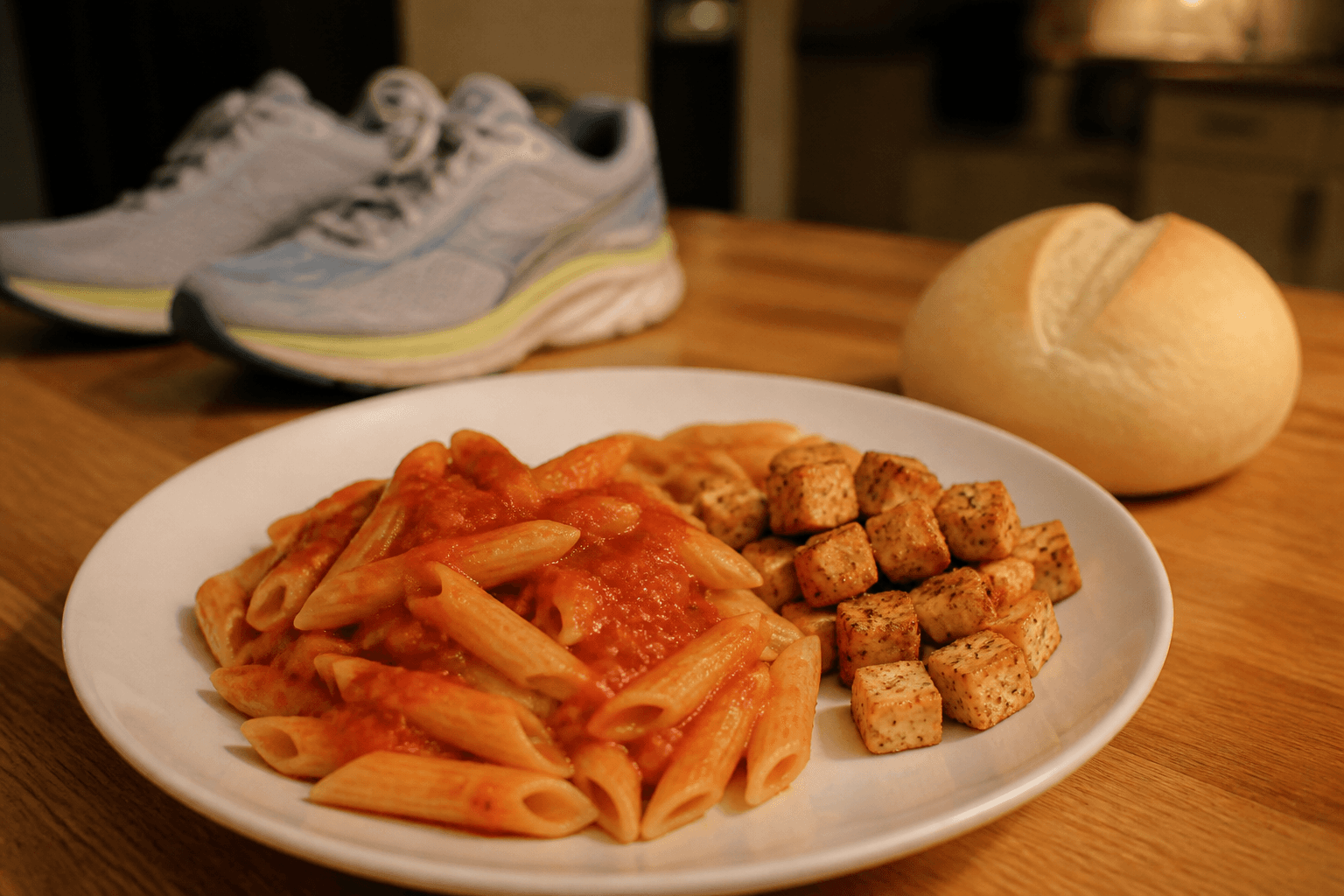
Taper week cuts training stress. For plant-based runners it should also cut intestinal residue, but not on the same calendar as mileage. Keep eating familiar food early in the week, start swapping oats and beans about three days out, and hold fiber near 15 g per day for the last 48 hours while carbohydrate rises toward the carb-load target.
High-fiber eating is excellent in January. It is a GI risk when you are about to bounce 30–50 km with less blood flowing to the gut. de Oliveira, Burini, and Jeukendrup (2014) put fiber on the contents side of that problem. Your job is to empty the pipeline without starving glycogen.
What “low fiber” means in a vegan taper
Not zero plants. Not a lifestyle. A temporary ceiling around 15 g of fiber per day for 48–72 hours, using refined grains and peeled produce, with protein from tofu rather than beans.
A normal plant-based day of 35–50 g of fiber is three times that budget. The taper is the week people try to “eat clean” harder — extra kale, extra oats — which is the opposite of the race-week job.
You still eat. Carbohydrate should be normal early in the week and then climb toward 8–12 g/kg in the last 36–48 hours, per Burke et al. (2011) and ACSM 2016. Fiber falls while carbs rise. Those are two different knobs.
The two tapers run on different clocks
Mileage tapers over two to three weeks. Fiber tapers over three days. Running them on the same schedule fails in both directions.
Some runners strip fiber for ten days, then spend the taper constipated, hungry, and convinced the diet is broken. Some remember fiber the night before and eat three-bean chili 20 hours out. The colon does not empty on a dinner-time decision.
Mileage taper: recovery and freshness. Fiber taper: what is physically in the intestine on Sunday morning. They share a week. They are not the same problem.
| Days out | Training | Fiber | Carbohydrate |
|---|---|---|---|
| 7–5 | Reduced volume, maybe a short sharp session | Start swapping whole grains → white at one or two meals; a normal salad at one meal is still fine | Training-week intake |
| 4–3 | Short and sharp or easy | Drop beans, chia, bran, crucifers | Begin to raise toward 7–8 g/kg |
| 2–1 | Shakeout only | Full ~15 g/day ceiling | 8–12 g/kg carb load |
Day-by-day plates for the last 72 hours are in what to eat 3 days before.
High-fiber vs low-fiber: what stays on the plate
| Category | Keep in the last 72 hours | Drop |
|---|---|---|
| Grains | White rice, white pasta, bagels, rice cakes, cream of rice, rice noodles | Brown rice, wholemeal bread, bran, steel-cut oats, quinoa |
| Protein | Firm tofu, fortified soy milk, 50 g tempeh only if the rest of the day is very low residue | Lentils, chickpeas, black beans, edamame, hummus |
| Produce | Ripe banana (budgeted), peeled cucumber or zucchini, pulp-free juice, applesauce | Broccoli, cauliflower, cabbage, Brussels sprouts, raw salads, berries, fruit with skin |
| Extras | Maple syrup, seedless jam, pretzels, soy sauce, small plain marinara | Chia, flax, nuts, seeds, sugar-free sweets, large garlic-onion sauces if you are FODMAP-sensitive |
White pasta at 2 cups cooked is 80 g of carbohydrate and 3 g of fiber. Whole-wheat pasta at 2 cups is 74 g of carbohydrate and 12 g of fiber. That one swap can be a third of the day’s ceiling. Brown rice versus white is 4 g versus 0.6 g of fiber per cup for the same 45 g of carbohydrate.
FODMAPs overlap this list even when the gram count looks small. Onion-heavy sauces, garlic bread, cauliflower, and a large apple can produce gas out of proportion to their fiber number. If you already know those foods bother you on long runs, they are gone from day −3, not “just a little” at Thursday dinner.
Office lunches are where tapers break. The grain bowl with chickpeas and slaw is the default plant option in most cafés. Order the rice bowl, ask them to hold beans and salad, add extra rice, and bring tofu from home if the café protein is falafel. A “small side of lentils” is still about 15 g of fiber.
A full day before and after the fiber cut
Same appetite, different residue. Numbers from the plantbaes.net foods table.
| Meal | High-fiber taper-week “healthy” day | Fiber (g) | Low-fiber swap | Carbs (g) | Fiber (g) |
|---|---|---|---|---|---|
| Breakfast | Steel-cut oats, chia, berries | 15 | White bagel, banana, 2 tbsp maple | 108 | 5 |
| Lunch | Chickpeas, kale, quinoa bowl (approx. chickpeas 1 cup + kale + quinoa) | ~20 | 2 cups white rice, 150 g tofu, soy sauce | 93 | 2 |
| Snack | Apple with skin, 1 oz almonds | 8 | Pretzels 1 oz, 8 oz pulp-free juice | 48 | 1.5 |
| Dinner | Whole-wheat pasta 2 cups, lentil-style ragu, side broccoli | ~20+ | 2 cups white pasta, 1/2 cup marinara, 50 g tempeh | 95 | 8 |
| Total (approx.) | ~50+ | ~344 | ~16 |
The swapped day is already at the fiber ceiling, which is why extra snacks must be maple, juice, rice cakes, or a drink mix — not another banana and a handful of nuts. If dinner uses rice noodles (2 cups, 70 g carbs, 1.5 g fiber) instead of pasta plus tempeh, you get headroom.
Liquid carbs help when chewing volume fails. Maurten Drink Mix 160 is 40 g of carbohydrate with no fiber. Tailwind Endurance Fuel is manufacturer-confirmed vegan; do not grab Tailwind Rebuild (whey) because the canister looks similar at the expo.
Protein, fluid, and the constipation question
Beans leave; protein should not. Firm tofu at 150 g is about 16 g of protein and 1 g of fiber. A cup of fortified soy milk adds about 7 g of protein. That is enough for 48 hours. You are not trying to max leucine this week. Training load is already down.
Fiber and fluid interact. Cutting fiber and cutting fluid — easy when you stop carrying a bottle because runs are short — is the combination that leaves you uncomfortable. Stored glycogen binds water, so a proper carb load already increases body water. Keep sipping to thirst. Pale-yellow urine is still the simple check.
If bowel movements slow, that is mostly lower residue, not a medical emergency by itself. Do not “fix” it with prunes, bran cereal, or sugar-alcohol gums. Those add the exact fermentable load you just removed. If you have a history of severe constipation or GI disease, that is a clinician conversation, not a blog protocol.
Skip new probiotics, magnesium oxide, and “keto” electrolytes with sugar alcohols. Race week is a closed kitchen.
Shakeout runs during the last 72 hours are short. Do not use them as a reason to eat a high-fiber “recovery bowl.” A 20–30 minute jog does not require a lentil refill. Water or a few sips of a practised mix such as Skratch Sport Hydration is enough beside the low-fiber meals you already planned.
If you train in a group that goes for pizza or a bean burrito after the last long run (often 10–14 days out, which is the rehearsal weekend, not race weekend), that is the session to eat the rehearsal menu, not the group default. Say so in advance. Social food is how fiber sneaks back in.
A seven-day food sketch you can actually cook
Days −7 to −5 can still look like your training diet at one meal. Use that to stay sane. Then lock the swaps.
| Day | Breakfast | Lunch | Dinner |
|---|---|---|---|
| −7 / −6 | Usual oats if that is your habit | Normal bowl; start thinking about shopping | White pasta once, beans still OK at one meal |
| −5 | Bagel or oats, not both with chia | Rice and tofu appearing | Last chili of the block if you insist — not later |
| −4 / −3 | Bagel or cream of rice, maple | Rice, tofu, cucumber | Rice noodles or white pasta, no broccoli |
| −2 / −1 | Bagel, maple; banana only if budgeted | Big rice portion, tofu | Early white starch; see night-before dinner |
Cook a pot of white rice on day −4 and keep it in the fridge. Race-week cooking energy is low. Reheating rice with soy sauce and tofu is how you avoid the takeaway grain bowl.
If you fly in on day −3, airport food is hostile: grain salads, snack nuts, “healthy” wraps. Pack bagels, pretzels, maple packets, and a ripe banana. Buy pulp-free juice after security. Hotel kettle protocol is in the night-before dinner article; start using it the night you land, not only Saturday.
The identity panic, and why you rehearse once
You will feel “unhealthy” eating white bagels. That feeling is identity, not physiology. Two days of refined starch do not undo a year of lentils. They do reduce the material the gut has to carry at 3:30 into a marathon.
The strongest counter is arithmetic. Once you have seen a normal day total 50 g of fiber, you are less likely to add a side salad on faith. That is the whole point of the checker on plantbaes.net.
Rehearse once, 10–14 days out:
- Low-fiber Saturday.
- Long run Sunday on the race breakfast you will actually use.
- Same drink mix you might sip in the load (Skratch Sport Hydration or Tailwind Endurance if those are your bottles).
You learn two things: whether the food sits, and whether the cupboard is stocked. Whole-wheat-only pasta on Saturday of race weekend is a self-inflicted problem.
The full gram targets live in the vegan carb loading guide. Offenders by food are in why beans and whole grains ruin a carb load. After the race, go back to normal plants with the recovery meal.
Frequently asked questions
What is a low-fiber diet for vegan runners?
How long before a race should I reduce fiber?
Does eating low fiber cause constipation before a race?
Can I still eat fruit during taper week?
Why does taper week feel so uncomfortable on a plant-based diet?
What should I eat instead of oats and beans during a vegan taper?
Should I practise a low-fiber taper before race week?
Sources
- Burke, L. M., Hawley, J. A., Wong, S. H., & Jeukendrup, A. E. (2011). Carbohydrates for training and competition. Journal of Sports Sciences.
- Thomas, D. T., Erdman, K. A., & Burke, L. M. (2016). ACSM Joint Position Statement: Nutrition and Athletic Performance.
- de Oliveira, E. P., Burini, R. C., & Jeukendrup, A. (2014). Gastrointestinal complaints during exercise. Sports Medicine.
- Jeukendrup, A. (2014). A step towards personalized sports nutrition: carbohydrate intake during exercise. Sports Medicine.
Educational content only. Carbohydrate, fiber, iron, B12, and hydration needs vary. Consult a sports dietitian or physician for individualized guidance — especially if you have a GI condition, anemia, or a history of underfueling.