
Recipes
Low-Fiber Vegan Pre-Run Breakfasts (Race-Week Safe)
White bagel, cream of rice, rice cakes, or juice: 1–4 g/kg of low-fiber carbohydrate before the run. Leave oats, chia, and berries until afterwards.
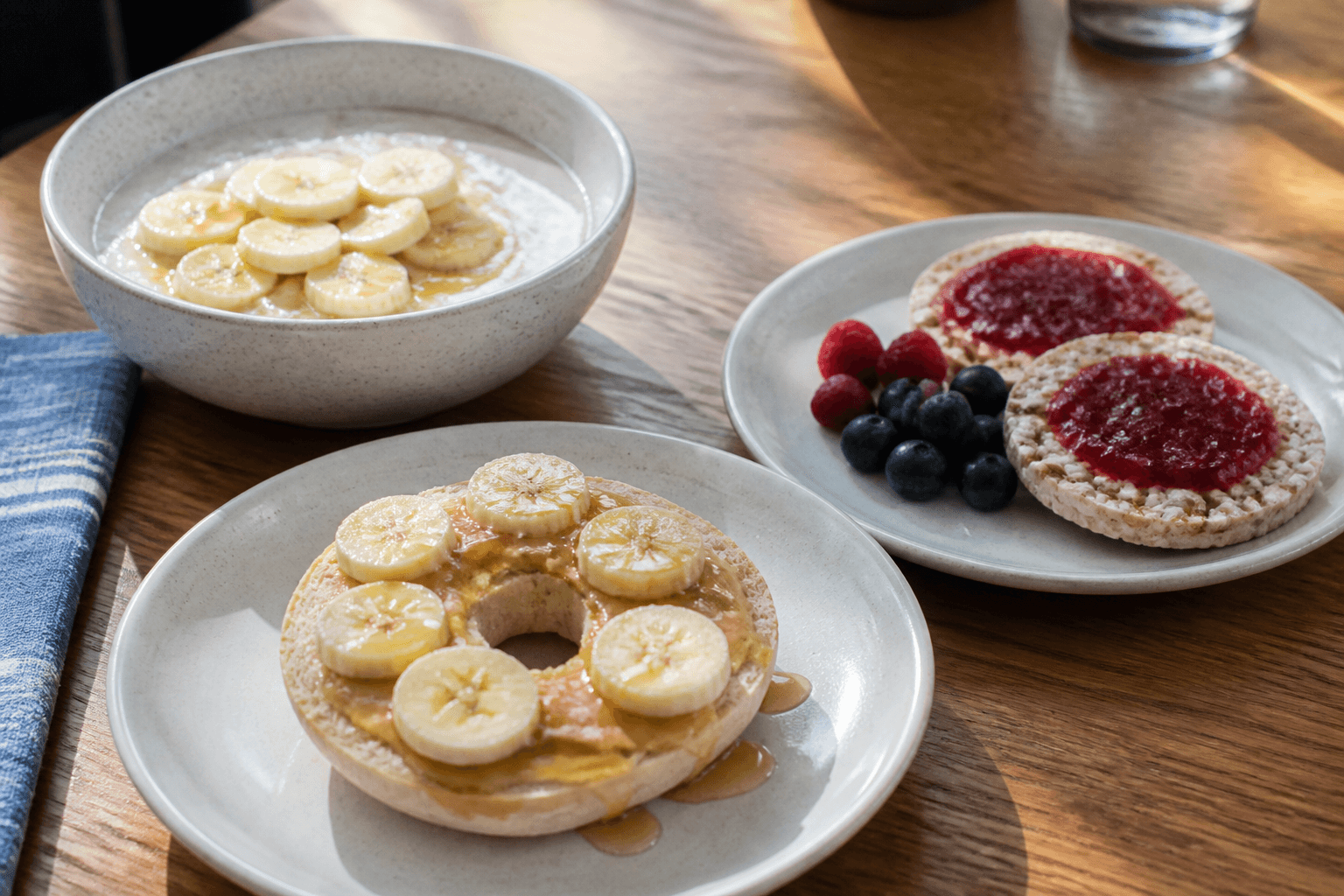
Practice these on long-run mornings, then repeat them in race week. The default plant-based breakfast — oats, chia, berries, nut butter — is an excellent everyday meal and a poor pre-race one: it stacks fiber and volume when you need 1–4 g of carbohydrate per kg with almost no residue (ACSM 2016).
A cup of cooked steel-cut oats is 4 g of fiber before you add anything. One tablespoon of chia is 5 g. A cup of mixed berries is 6 g. That bowl can spend the entire ~15 g daily ceiling used on plantbaes.net before you put shoes on. Swap the vehicle, keep the calories.
How much carbohydrate, and how far out?
Match meal size to the hours you have. Four hours allows more chewing. Two hours wants liquid and less fiber. Most 7:00 a.m. marathons land near 2.5–3 hours, not a 4 a.m. banquet. Full clock math: race-day breakfast timing.
For a 70 kg runner, 1.5–2.5 g/kg three hours out is about 105–175 g of carbohydrate. The bagel breakfast below is 108 g — a solid default, not a maximum. Juice or a second bagel fills the top of the range only if you have already run on that volume.
| Hours before the gun | Carbohydrate (70 kg) | Default plate |
|---|---|---|
| ~4 hours | ~140–180 g if tolerated | Bagel plate plus juice or a second bagel |
| ~3 hours | ~110–175 g | Bagel, banana, maple — or cream of rice |
| ~2 hours | ~60–90 g, more liquid | Rice cakes and jam, juice, or half a bagel |
| Corral, 10–15 minutes | 25–30 g extra | Practised Maurten Gel 100 or Neversecond C30 |
Protein at this sitting is secondary. A cup of fortified soy milk adds 7 g of protein and 1 g of fiber if you want it; peanut butter and chia do not belong on race morning. Leucine can wait for the recovery meal. Ivy 2002 is a post-exercise glycogen paper, not a reason to force tofu at 4:30 a.m.
White bagel, banana, maple
Toast one white bagel (100 g): 55 g carbohydrate, 2 g fiber, 10 g protein. Mash one ripe banana (27 g carbohydrate, 3 g fiber). Add 2 tablespoons maple syrup (26 g carbohydrate, 0 g fiber). Optional splash of fortified soy milk.
Meal total: about 108 g carbohydrate, 5 g fiber, 11 g protein (the composite bagel-and-banana row in the foods table).
This is the workhorse. It travels, it needs a toaster, and most hotels have a version of it. Ask for plain white, not everything bagel. Seeded crusts are a fiber surprise. If the buffet only has whole-wheat, buy a grocery-store white bagel the night before — that is cheaper than a GI experiment at 5 a.m.
If you need more grams and have four hours, add a second bagel or 8 oz pulp-free orange juice (26 g carbohydrate, 0.5 g fiber). If you have only two hours, eat half and drink the rest as juice.
Cream of rice
Cook 1 cup cream of rice: 28 g carbohydrate, 0.5 g fiber, 3 g protein. Stir in 2 tablespoons maple and one sliced ripe banana.
You land near 81 g carbohydrate and 4 g fiber — lower residue than any oat bowl that looks similar in the mug. Instant sachets work in a hotel kettle. That matters on a cold race morning when you want a warm breakfast without steel-cut leftover fiber.
Do not “fortify” it with chia, flax, or peanut butter in the last 48 hours. Those are training-week toppings. If you want protein in the bowl, a few tablespoons of silken tofu or extra soy milk add far less fiber than seeds. Taste the salt level at home: some cream-of-rice products are bland enough to need a pinch of salt plus maple, which is still lower residue than a handful of nuts.
Rice cakes and jam, or liquid when time is short
Three plain rice cakes are 21 g carbohydrate and 0.4 g fiber. Two tablespoons seedless jam add 26 g carbohydrate and 0.5 g fiber. Meal total about 47 g carbohydrate and 1 g fiber. Add pretzels (1 oz is 22 g carbohydrate, 1 g fiber) if you need salt and more grams.
Seedless is the operative word. Berry jams with seeds add fiber for no benefit.
When the gun is under two hours away, or nerves have removed appetite, go liquid-leaning: 8–16 oz pulp-free orange juice plus rice cakes, or a manufacturer-confirmed carb drink you already gut-trained. Maurten Drink Mix 160 is about 40 g of carbohydrate with no fiber. Tailwind Endurance Fuel is manufacturer-confirmed vegan; Tailwind Rebuild is whey — not vegan. Skratch Sport Hydration is a lighter carb mix; Skratch Recovery is dairy.
A practised Maurten Gel 100 (25 g) or Neversecond C30 (30 g) 10–15 minutes before the start is race fuel, not breakfast. Do not open an aid-station honey gel in the corral.
| Breakfast | Carbs (g) | Fiber (g) | Best for |
|---|---|---|---|
| Bagel + banana + maple | 108 | 5 | 3–4 hours out |
| Cream of rice + maple + banana | 81 | 4 | 3 hours out, cold mornings |
| Rice cakes + seedless jam | 47 | 1 | 2 hours out, nervous stomach |
| Juice + rice cakes | ~47–73 | ~1 | Under 2 hours |
What these replace
Swap the vehicle. Keep the idea of “breakfast.”
| Usual breakfast | Fiber (g, approx.) | Swap to | Fiber (g) |
|---|---|---|---|
| Steel-cut oats, 1 tbsp chia, 1 cup berries | ~15 | Bagel, banana, maple | 5 |
| Whole-wheat toast with peanut butter | ~7–9 | White bagel or white toast with jam | ~2–3 |
| Bran cereal with soy milk | often 8–12 | Cream of rice with maple | ~4 with banana |
| Smoothie with spinach and flax | ~8+ | Pulp-free juice, or soy milk without greens | ~0–1 |
Avocado toast is a fat-and-fiber plate (half an avocado is 5 g fiber and 6 g carbohydrate). It is a poor carb-delivery tool the morning of a long run.
Coffee stays at the usual dose if it is the usual habit. Strip the cacao nibs and giant oat-milk mocha. Timing with iron is a training-week issue, not a race-morning ferritin project — see plant-based iron if that is your question.
Pack it, and do not improvise at the hotel
Bring the bagel, the maple, the banana, and the drink mix you already used. Hotel oatmeal, expo samples, and “healthy” buffet fruit bowls are how practiced guts get surprised.
If breakfast was small because the shuttle was early, you still have the load from the days before and the hourly race fuel after the gun. Do not cram a 4 g/kg breakfast into 75 minutes.
Cream of rice in a hotel: empty the sachet into a mug, add kettle water, wait, then maple and banana. Taste it at home first; some sachets are saltier than others. A second white bagel from the buffet is safer than the granola station. Skip the nut butter “just a smear.” Two tablespoons of peanut butter is 3 g of fiber and 8 g of protein you do not need before the start. If you want salt, pretzels are the lower-fiber tool — 1 oz is 22 g of carbohydrate and 1 g of fiber.
After the finish, fiber can return. The first meal can be the recovery smoothie or rice plate. Training dinners with beans live in high-carb dinner bowls.
Frequently asked questions
What is a good low-fiber vegan breakfast before running?
Can I eat oatmeal before a long run?
What should I eat before an early morning run?
How many carbs should a pre-run breakfast have?
Are bananas low in fiber?
Should I practise these breakfasts before race day?
Can I drink coffee with a low-fiber breakfast?
Sources
- Thomas, D. T., Erdman, K. A., & Burke, L. M. (2016). ACSM Joint Position Statement: Nutrition and Athletic Performance.
- Ivy, J. L., et al. (2002). Early postexercise muscle glycogen recovery is enhanced with a carbohydrate-protein supplement. Journal of Applied Physiology.
- van Vliet, S., Burd, N. A., & van Loon, L. J. C. (2015). The skeletal muscle anabolic response to plant- versus animal-based protein. Journal of Nutrition.
Educational content only. Carbohydrate, fiber, iron, B12, and hydration needs vary. Consult a sports dietitian or physician for individualized guidance — especially if you have a GI condition, anemia, or a history of underfueling.