
Marathon fueling
Preventing Runner's Diarrhea on a Plant-Based Diet
Cut fiber to ~15 g/day for 36–48 hours, gut-train the exact gels you will use on Sunday, and do not stack caffeine, fructose, and a new packet at mile 18.
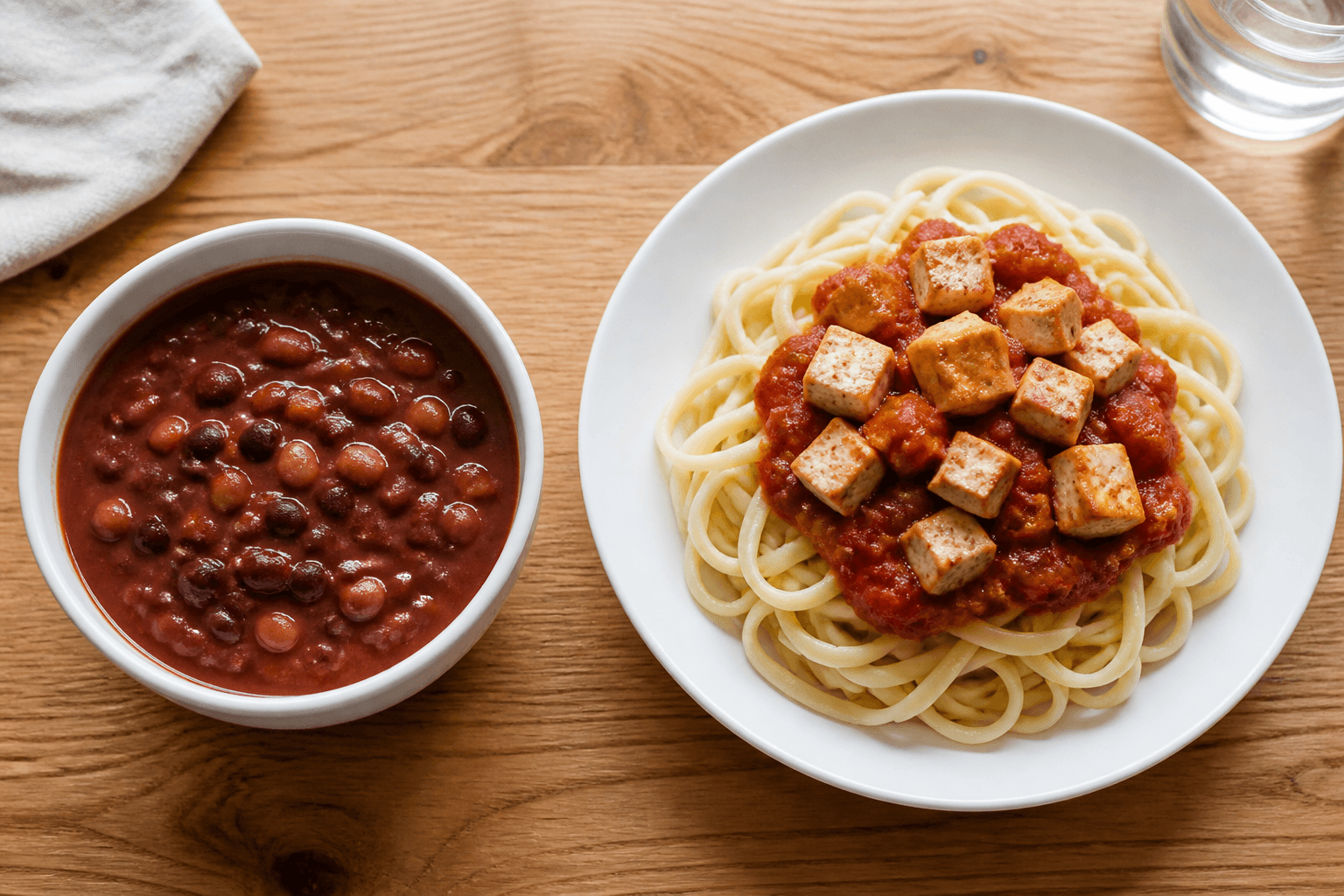
Runner's diarrhea is mechanical gut stress plus whatever is sitting in the intestine. Hard running cuts splanchnic blood flow and shakes the bowel; fiber, FODMAPs, concentrated sugar, caffeine, and NSAIDs decide how ugly that combination gets. A plant-based diet does not give you a different gut. It loads the contents side, which is why mile 18 trouble is more often a race-week food problem than a moral one.
Cut fiber to about 15 g per day for the final 36–48 hours, gut-train the exact products you will use, and do not stack a new gel, a large coffee, and Friday's chili on the same morning.
What actually happens to the gut at marathon pace
At high intensity, blood is redirected to working muscle and to the skin for cooling. Gut perfusion can fall sharply. Absorption slows. The intestinal barrier is under more stress. Running adds a mechanical load cycling does not: repeated impact, psoas movement, and a bouncing colon.
de Oliveira, Burini, and Jeukendrup (2014) put GI complaints in a large share of endurance athletes, with running worse than cycling, and listed fiber, fat, protein, highly concentrated carbohydrate, caffeine, and NSAIDs among the nutritional aggravators. Costa and colleagues (2017) describe exercise-induced gastrointestinal syndrome as two overlapping pathways — circulatory-gastrointestinal and neuroendocrine-gastrointestinal — which is a long way of saying the gut is ischemic, hormonally stimulated, and being shaken at the same time.
None of that is vegan-specific. The same physiology hits everyone at 4:50/km. What diet controls is residue volume, fermentable substrate, and whether the carbohydrate you take during the race is a concentration and a fructose:glucose mix you have already practised.
This is why a breakfast that is unremarkable on a rest day becomes a problem at 30 km. The food did not change. The blood flow did.
Running starves and shakes the gut. Diet cannot stop that. Diet decides how much material and which sugars are present when it happens.
The plant-specific contents problem
A typical plant-based pattern is high in fiber (often 35–50 g/day) and high in FODMAPs: galacto-oligosaccharides in beans, fructans in wheat, onion, and garlic, excess fructose in dried fruit and some juices, polyols in sugar-free gum and stone fruit.
FODMAPs pull water into the small intestine and ferment in the colon. That is useful for everyday bowel regularity. It is a liability when splanchnic flow is down and you still have 18 km to run.
This is not an argument for a permanent low-FODMAP diet. Those patterns are restrictive, easy to get wrong, and not intended as a lifestyle. It is a two-day filter that overlaps with the low-fiber carb-load protocol.
| FODMAP group | Before (common plant sources) | After (race-week alternative) |
|---|---|---|
| Galacto-oligosaccharides | Lentils, chickpeas, black beans, soy beans, hummus | Firm tofu (much lower GOS) |
| Fructans | Wheat, onion, garlic, many marinara jars | Rice, rice noodles, plain low-onion tomato sauce |
| Excess fructose | Apple, mango, dried fruit, agave, some fruit gels | Ripe banana, maple syrup, glucose-fructose gels you have trained with |
| Polyols | Sugar-free gum and sweets, stone fruit, some "keto" bars | Skip entirely in race week |
A 1.5-cup lentil soup is ~15 g of fiber plus a GOS load. A cup of black beans is the same story. Three-bean chili at 1.5 cups is ~16 g. Any one of those on Friday night is still in play on Sunday morning for a lot of runners.
Onion and garlic are the sauces people forget. A "simple" pasta can still be a fructan bomb if the jar leads with both. If you know you are sensitive, pick a plain tomato or olive-oil sauce and add salt, not a handful of raw onion.
The vegan GI stack is fiber plus FODMAPs, not "being vegan." Two days of tofu, rice, and peeled produce cuts both. It is not a diet you keep.
Ranked levers that actually move
Order matters. Most runners rearrange gels while still eating 40 g of fiber.
- Race-week fiber ceiling, ~15 g/day for 36–48 hours. Largest contents change you can make. Details and swaps sit in why high-fiber foods ruin a carb load.
- Gut-train the exact race fuel at the exact hourly rate, including water with each gel.
- Do not stack fructose on a high-fiber breakfast. Dates plus oats plus a fruit gel is a common own-goal.
- Caffeine is a dose. ISSN (Guest et al., 2021) supports about 3–6 mg/kg. Motility is a known effect. Practise the cup or skip it.
- Fluid with carbohydrate, not a concentrated gel dry. ACSM fluid guidance (Sawka et al., 2007) is about euhydration, not a sloshing stomach. Take packets at aid stations so water arrives with them.
- Nothing new in race week. No new probiotic, magnesium oxide, sugar-free gum, "gut-health" gummy, or expo-table flavor.
| Before | After | Why the second version sits better |
|---|---|---|
| Oat-chia breakfast, then a fruit-puree gel at mile 8 | White bagel and banana, then Maurten Gel 100 or Neversecond C30 with water | Lower residue, lower chia fiber, practised concentration |
| Friday three-bean chili, Saturday "easy" salad | Friday rice and tofu, Saturday white pasta | GOS and salad fiber are not still in the colon |
| Coffee plus two 100 mg caffeinated gels, never totalled | Usual coffee (~3 mg/kg total day, gels counted) | Motility and jitter scale with milligrams |
| New Huma chia flavor from the expo | The Maurten, GU, or Neversecond packet from long runs | Novelty is a GI risk independent of ingredients |
Underfueling is not a lever. Carbohydrate during the race still sits in the 30–60 g/h band for a single source, 60–90 g/h if you have trained multiple transportable carbohydrates (Thomas, Erdman & Burke, 2016). Arriving empty to "spare the gut" produces its own nausea, and it produces a crash that people then treat with three gels at once.
Fiber first, then practised fuel, then caffeine and fluid. New products and stacked fructose are how a good plan still fails at 32 km.
Gut training is a real intervention
Tolerance for concentrated carbohydrate improves with repeated exposure. That is not folklore. The transporters and the stomach's willingness to empty a 25–40 g gel at race intensity both respond to practice.
A workable block:
- Use the same products at the same grams per hour across at least three long runs, ideally more.
- Build the rate. If 90 g/h is the goal, do not debut it at 32 km of the marathon. Step 45 → 60 → 75 → 90 in training.
- Always take gels with water. A Maurten Gel 100 or Neversecond C30 taken dry is a different osmotic load from the same packet plus 150–200 ml of fluid.
- Run at least one session at goal race pace with full fuelling. Easy-pace guts lie.
- Practise the race-morning breakfast 2–4 hours before that session, including the coffee decision.
Brand does not replace this. Maurten's hydrogel is easier for some runners and irrelevant for others. Tailwind as a drink-only plan removes chewing, which helps some stomachs and bores others. GU original gels are a known 22 g hit if you have checked that flavor's panel. None of them forgive an untrained 90 g/h.
Carry what you verified. Aid stations hand out honey gels and dairy recovery cartons. Honey Stinger is not vegan. The gels and chews catalog is the filter; the long run is the test.
Gut training means the same packets, the same hourly grams, with water, at race pace, more than once. A new "gentle" gel on the start line is still a new gel.
Race fuel that looks gentle and is not
"Natural" is not a GI category. Fiber and fructose are.
Huma chia gels are manufacturer-confirmed vegan on brand language and they contain chia on purpose. That extra fiber is a feature in marketing and a variable in your 15 g budget. Spring Energy fruit sauces can sit well for the runner who trained them and sit badly for the runner who switched from a maltodextrin gel because the packet looked closer to food.
Date-based and puree products often lead with fructose. Fructose uses GLUT5; glucose uses SGLT1. A mix is how trained athletes push toward 90 g/h. A fructose-heavy packet on top of dried fruit at breakfast is a malabsorption experiment.
Sugar alcohols in "keto" chews and some electrolyte products cause osmotic diarrhea in people who tolerate the rest of their plan. Sucralose bothers some runners and none of others. Individual, and not a reason to start a new sweetener in race week.
Compare a conventional packet with a "food" packet on the variables that matter:
| Product type | Carbs per packet (typical) | Fiber / residue | Race-week note |
|---|---|---|---|
| Maurten Gel 100 | 25 g | Negligible | Manufacturer-confirmed vegan; train the hydrogel texture |
| Neversecond C30 Gel | 30 g | Negligible | Easy math at 60–90 g/h; manufacturer-confirmed vegan |
| GU Energy Gel (original, flavor-checked) | ~22 g | Negligible | Ingredient-list verified per flavor; do not assume Roctane is the same |
| Chia or fruit-puree gel | ~19–26 g | Often higher | Only if long runs were done on this exact flavor |
| Honey gel (Honey Stinger, some others) | ~24 g | Low fiber, not vegan | Wrong product if you are eating plant-based |
Skratch Sport Hydration (~21 g carbohydrate, ~380 mg sodium per serving) and Tailwind Endurance Fuel (~25 g carbohydrate, ~310 mg sodium) can replace some chewing. That helps runners whose GI trigger is the gel texture itself. It does not help if you then eat a high-fiber breakfast because "the drink is so clean." See the electrolyte drink mix guide for which canisters are fuel and which are sodium-only — LMNT and Precision Hydration 1500 contain no carbohydrate.
Gentle is practised concentration, not a leafy label. Chia, dates, and honey each fail a different test: fiber, fructose, or vegan status.
Race morning: breakfast, coffee, fluid
Finish breakfast two to four hours before the gun, on foods you have already emptied before a long run. White bagel, maple or seedless jam, ripe banana, a splash of fortified soy milk if that is your habit. That plate is about 80–110 g of carbohydrate and roughly 5 g of fiber. It is not the morning for overnight oats.
Caffeine: keep the habitual dose. Guest et al. (ISSN, 2021) support 3–6 mg/kg about 45–60 minutes pre-effort. For a 70 kg runner the low end is ~210 mg. A drip coffee can be ~165 mg in 350 ml; Maurten Gel 100 Caf 100 is 100 mg; Neversecond C30 Caffeine is 75 mg. Add them up in advance. If coffee reliably sends you to the porta-potty, skip the cup and use the gel you tested. Motility is a real effect, not a weakness.
Fluid: start euhydrated, not sloshing. A common range is 400–600 ml in the two hours before the start, with small sips only in the last 15 minutes (see race-morning hydration). Large volumes of plain water without sodium help nobody, and they raise hyponatremia risk in slower drinkers who keep sipping from nerves.
NSAIDs before a marathon are a separate gut insult. They are not a fuelling tool. If you use them for a known injury, that is a conversation with the clinician who knows the injury — not a start-line ibuprofen as "insurance."
Race morning is a rehearsal: low-fiber breakfast 2–4 hours out, caffeine at the practised milligram total, modest fluid, no new packets, no casual NSAID.
What is not the fix, and when to stop self-coaching
Stopping all carbohydrate is not the fix. Neither is a ten-day white-food stretch that leaves you constipated and under-fuelled. Neither is a new probiotic, a charcoal tablet, or a last-minute low-FODMAP app diet you have never shopped.
Imodium (loperamide) is not a training plan. Some clinicians use anti-motility agents in selected athletes with a documented pattern. That is individualized medicine. Taking it because a forum thread was confident does not address fiber, fuelling rate, or caffeine, and it can slow emptying you still need for 60–90 g of carbohydrate per hour.
Red flags that are not "runner's gut":
- Blood in the stool
- Fever
- Symptoms that continue for days after you stop running
- Night-time diarrhea
- Unexplained weight loss
- Onset after travel with possible infection
Those need a physician. Iron deficiency, celiac disease, IBD, and bile-acid problems exist in runners too. A low-fiber taper will not diagnose them.
For everyone else, the work is boring and effective: 15 g of fiber, practised packets, counted caffeine, water with the gel. Put the lentils back on Monday.
Do not treat underfueling, ten-day restriction, or unprescribed anti-motility drugs as the solution. Blood, fever, or rest-day symptoms leave this page and go to a clinic.
Frequently asked questions
What causes runner's diarrhea?
How do I stop GI issues during a marathon?
Are vegan runners more prone to GI problems?
Do natural or real-food gels cause fewer problems?
Should I take Imodium before a race?
When are GI symptoms a medical problem?
How many carbs per hour can I take without wrecking my gut?
Does coffee cause runner's diarrhea?
Sources
- de Oliveira, E. P., Burini, R. C., & Jeukendrup, A. (2014). Gastrointestinal complaints during exercise: prevalence, etiology, and nutritional recommendations. Sports Medicine.
- Costa, R. J. S., Snipe, R. M. J., Kitic, C. M., & Gibson, P. R. (2017). Systematic review: exercise-induced gastrointestinal syndrome. Alimentary Pharmacology & Therapeutics.
- Thomas, D. T., Erdman, K. A., & Burke, L. M. (2016). ACSM Joint Position Statement: Nutrition and Athletic Performance.
- Sawka, M. N., et al. (2007). ACSM position stand: exercise and fluid replacement.
- Guest, N. S., et al. (2021). International Society of Sports Nutrition position stand: caffeine and exercise performance. Journal of the International Society of Sports Nutrition.
Educational content only. Carbohydrate, fiber, iron, B12, and hydration needs vary. Consult a sports dietitian or physician for individualized guidance — especially if you have a GI condition, anemia, or a history of underfueling.