
Recipes
High-Carb Plant-Based Dinner Bowls for Heavy Training Weeks
Rice, pasta, or potato with 20–30 g of protein. Beans belong in the training block; swap to tofu and white starch only in the last 48 hours before a race.
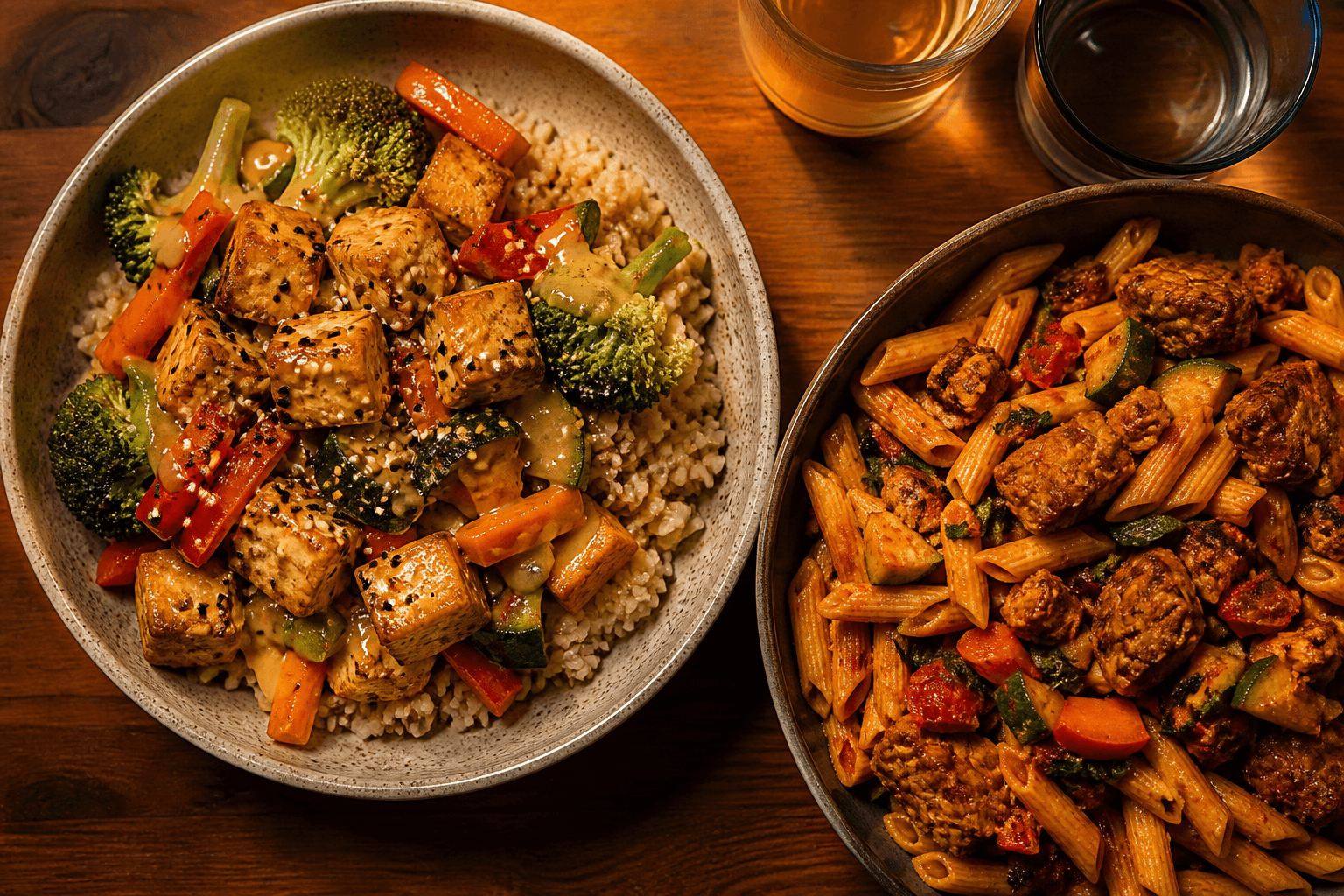
Heavy mileage wants carbohydrate and a recovery protein serving. Fiber is welcome in the training block. Do not use these bowls in the 48 hours before a goal race.
This page is the counterweight to the rest of the race-week material. Most of that writing is about temporarily removing fiber. The restriction only makes sense because the other fifty weeks look like this: beans, brown rice if you like it, broccoli, chili. Then you know how to strip it.
What dinner is supposed to do on a high-mileage day
ACSM 2016 still scales carbohydrate to training load. Easy or rest days often sit near 5–7 g/kg. Hard endurance days climb toward 6–10 g/kg. The 8–12 g/kg band is the pre-race load, not every Tuesday.
Dinner is usually the largest sitting. For a 70 kg runner, a long-run night might put 150–200 g of carbohydrate on the evening plate, with more earlier in the day. Protein in the bowl should land near 0.3 g/kg — about 21 g — because plant proteins are lower in leucine per gram (van Vliet 2015; Gorissen 2018). That is 200 g of tofu, 100 g of tempeh, or a cup of lentils, not a sprinkle of hemp hearts.
Ivy et al. (2002) is a reminder that carbohydrate plus protein can support glycogen refill after hard work. Total daily carbohydrate still outranks beating a 30-minute clock. Eat the bowl when you can chew; if the session wrecked appetite, start with rice and soy milk and finish the vegetables later.
Evening sessions need a split. A small low-fiber carb snack 60–90 minutes before intervals — white toast and jam, or rice cakes — then the full bowl afterwards. A 1.5-cup chili an hour before 800s is how people learn about runner’s GI the hard way. Morning long runs can use the low-fiber breakfasts and still have this bowl at night; you do not have to eat race-week food all day in week 12 of the block.
Rice and tofu, training version
2 cups cooked rice is 90 g carbohydrate if white, or about the same carbohydrate with 8 g of fiber if brown (4 g per cup). Add 150 g firm tofu (16 g protein, 1 g fiber), mixed vegetables, and soy sauce.
Training-week extras that belong here: a cup of edamame (18 g protein, 8 g fiber) if your gut is happy the next morning, or leftover lentils. Race-week extras that do not: those legumes, a kale pile, chili on the side.
Brown rice is fine in January. Save the white-rice version for taper. Approximate training bowl: 110 g carbohydrate and 20 g protein before extras. Push toward 180 g of carbohydrate on double days with a third cup of rice, a banana, or juice.
This is also a reasonable iron meal in the training block if you add peppers or tomato and keep coffee an hour away — see plant-based iron. It is not a reason to keep brown rice on Friday of race week.
Pasta bowl and potato bowl
Pasta. Two cups cooked white pasta is 80 g carbohydrate, 3 g fiber, 14 g protein. Whole-wheat pasta at the same volume is 74 g carbohydrate and 12 g fiber. Use whole wheat when you are not racing on Sunday. Marinara at 1/2 cup is 10 g carbohydrate and 2 g fiber. Tempeh at 100 g (scale the 50 g table row) or 200 g tofu supplies the protein cap. Spinach can go in during training weeks.
Two cups of pasta with a tempeh ragu lands near 100 g carbohydrate and 25 g protein. A white dinner roll on the side is 20 g more carbohydrate at 1 g of fiber — the simplest way to push a heavy day upward.
Potato. One large peeled white potato is 50 g carbohydrate and 2 g fiber. Skin-on sweet potato is a training food (about 4 g fiber). Baked beans on top are a training-week protein move and a race-week mistake. Tofu or a modest soy-milk mash keeps protein without the bean load.
The potato bowl is the cheapest of the three and the highest in potassium. Skin-on potato plus baked beans is also the highest-fiber option on this page, which is exactly why it is a training meal.
| Training day | Daily carb target (guide) | Dinner share (70 kg) | Practical bowl |
|---|---|---|---|
| Easy or rest | ~5–6 g/kg | ~100 g | Standard bowl, no extras |
| Moderate volume | ~6–8 g/kg | ~130 g | Bowl plus bread or fruit |
| Long run or double | ~8–10 g/kg | ~180 g | Larger grain base, fruit, juice alongside |
Training bowl versus race-week bowl
Three swaps, not a new cuisine.
| Training version | Race-week version |
|---|---|
| Brown rice or quinoa | White rice or rice noodles |
| Whole-wheat pasta | White pasta |
| Baked beans, lentils, chili | Firm tofu (150–200 g) |
| Broccoli, kale, cabbage | Peeled zucchini, cucumber, or omit |
| Skin-on potato | Peeled potato or instant mash |
| Plate | Training macros (approx.) | Race-week macros (approx.) |
|---|---|---|
| Chili night (1.5 cups three-bean) | 45 g carbs, 16 g fiber, 18 g protein | Swap to pasta + tofu: ~93–95 g carbs, ~5–8 g fiber, ~30 g protein |
| Rice bowl, 2 cups brown + tofu + broccoli | ~90 g carbs, ~9 g fiber, ~20 g protein | White rice + tofu, skip broccoli: 93 g carbs, 2 g fiber, 24 g protein |
| Whole-wheat pasta, 2 cups, + lentils | high fiber, easy to exceed 15 g | White pasta, small marinara, tofu |
The carbohydrate stays or rises. The fiber leaves. Check the result rather than guessing. The full night-before plate is night-before dinner. Breakfast the next morning is low-fiber vegan breakfasts.
Protein, powders, and what does not belong in the bowl
Aim for roughly 0.3 g/kg in the bowl. Distribute the rest of the day’s protein across breakfast and lunch — that matters more on a plant diet (leucine article).
You do not need Garden of Life Sport, Vega Sport Premium Protein, or Orgain on top of 200 g of tofu. Those powders help when you are travelling or when dinner is late and small. Tailwind Rebuild is whey. Skratch Recovery contains milk protein. Do not pour them over rice because the hydration canister from the same brand is vegan.
Maurten Gel 100 and Neversecond C30 are not dinner. If you still need carbohydrate grams after a huge session and cannot chew another cup of rice, juice or a practised drink mix is cleaner than a gel at the table.
Iron-rich bean bowls belong in this training pattern, not in taper — plant-based iron. B12 still comes from your daily fortified source or tablet, not from the broccoli.
The working fiber ceiling on plantbaes.net is about 15 g per day only for the last 36–48 hours. The rest of the year, eat the beans.
Frequently asked questions
What should runners eat for dinner during heavy training?
How many carbs do runners need on high-mileage days?
Can I eat beans during marathon training?
What is the difference between a training bowl and a race-week bowl?
Should I eat dinner before or after an evening run?
Do I need a recovery powder with dinner?
How do I scale the bowl on an easy day versus a long-run day?
Sources
- Thomas, D. T., Erdman, K. A., & Burke, L. M. (2016). ACSM Joint Position Statement: Nutrition and Athletic Performance.
- van Vliet, S., Burd, N. A., & van Loon, L. J. C. (2015). The skeletal muscle anabolic response to plant- versus animal-based protein. Journal of Nutrition.
- Gorissen, S. H. M., et al. (2018). Protein content and amino acid composition of commercially available plant-based protein isolates. Amino Acids.
- Ivy, J. L., et al. (2002). Early postexercise muscle glycogen recovery is enhanced with a carbohydrate-protein supplement. Journal of Applied Physiology.
Educational content only. Carbohydrate, fiber, iron, B12, and hydration needs vary. Consult a sports dietitian or physician for individualized guidance — especially if you have a GI condition, anemia, or a history of underfueling.