
Marathon fueling
Do Plant-Based Runners Need More Protein? What the Research Says
Hit 1.2–2.0 g/kg with tofu, soy milk, and legumes. Plant protein is a serving-size issue, not a 50% vegan surcharge, and race week still needs tofu.
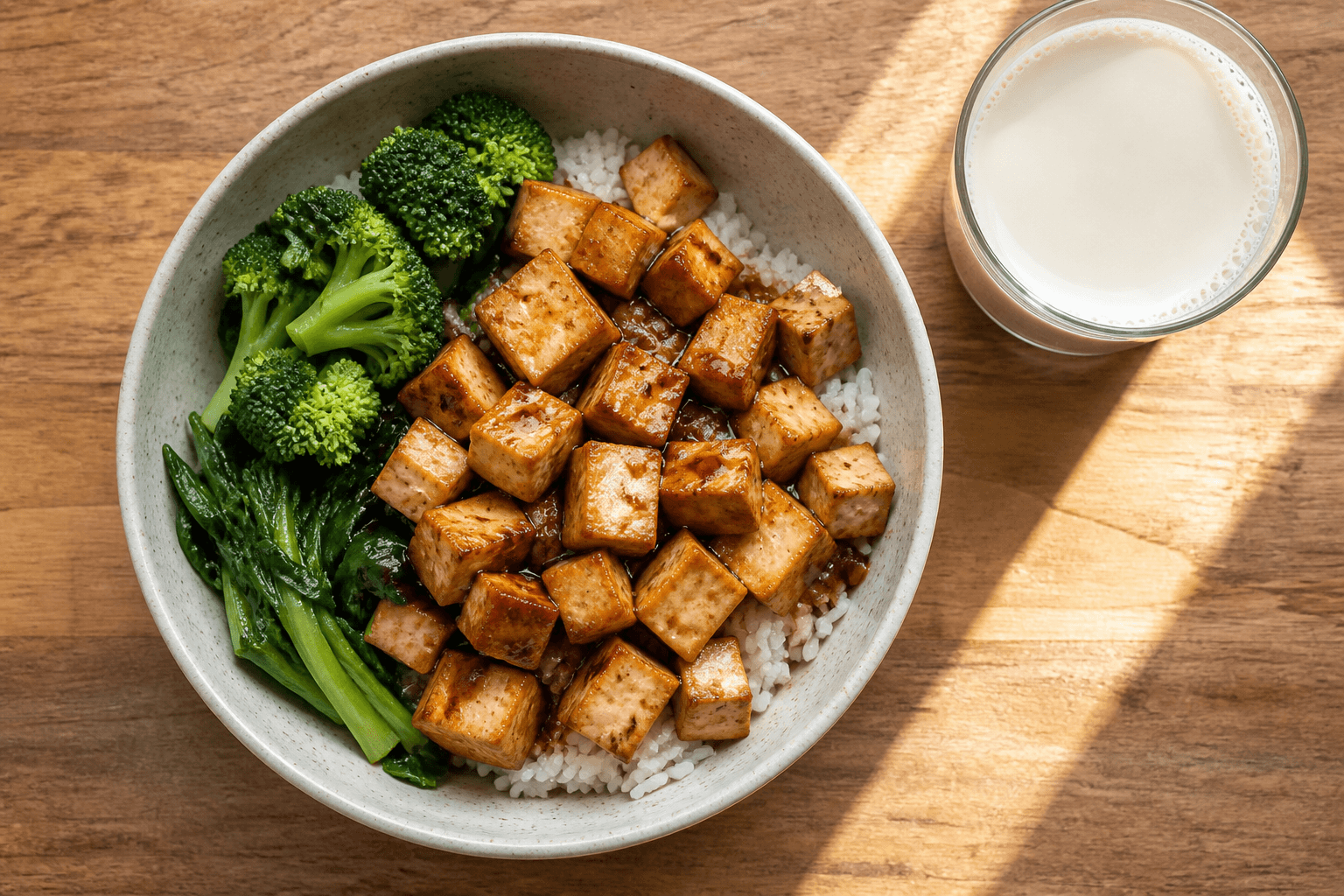
ACSM 2016 still puts endurance athletes around 1.2–2.0 g of protein per kg per day, scaled to load and energy availability. Plant-based runners need to hit that range with food that exists in their diet, not a mystical vegan surcharge of +50% with no method behind it. The plant-specific wrinkles are digestibility, leucine per serving, and race week — when beans leave and tofu has to show up.
Per-meal leucine math is in leucine and plant protein. Iron and B12 are separate jobs: iron and B12 overview.
What the plant-specific difference actually is
Two real differences exist. Neither justifies doubling the daily target.
Digestibility. Plant proteins are somewhat less digestible than animal proteins, partly because of fiber and antinutrients they arrive with. Processing helps: tofu is considerably more digestible than whole soybeans. Isolates used in powders are more digestible than a pot of under-cooked beans.
Amino acid profile. Most plant proteins are lower in one or more essential amino acids, and lower in leucine specifically. Legumes tend to be short on methionine, grains on lysine. Eating both across a day resolves this without combining rituals at a single meal. Soy is the notable exception on both counts, which is why tofu and soy milk do so much work here. Tempeh is useful in training weeks at a higher fiber cost. Seitan is wheat protein and leucine-reasonable for people who tolerate gluten; it is not a race-week experiment if you have not used it on long-run weekends.
van Vliet, Burd, and van Loon (2015) showed that matched plant-protein servings often produce a smaller muscle protein synthesis response than animal proteins. The practical translation is a larger serving or a soy-forward choice, not a verdict that plant protein “doesn’t work.”
Gorissen et al. (2018) mapped leucine in commercial isolates: whey is leucine-dense; soy and pea isolates sit lower. That paper is why a 20 g pea scoop is not 1:1 with a 20 g whey scoop.
Hitting the target in practice
For a 70 kg runner aiming at 1.6 g/kg — about 112 g per day — the plantbaes.net foods table makes the arithmetic visible:
| Food | Portion | Protein (g) | Fiber (g) |
|---|---|---|---|
| Firm tofu | 200 g | ~21 | ~1.3 |
| Fortified soy milk | 500 ml (~2 cups) | ~14 | ~2 |
| Cooked lentils (as soup, 1.5 cups) | 1.5 cups | 18 | 15 |
| Tempeh | 50 g (race-week cap) | 10 | 3 |
| White pasta, cooked | 2 cups | 14 | 3 |
| Peanut butter | 2 tbsp | 8 | 3 |
The fiber column is the whole race-week problem in one glance: lentils are efficient protein and expensive residue. Pasta contributes more protein than people think, but it will not carry a day by itself.
A workable training day for 112 g is not exotic: tofu at lunch, lentils or tempeh at dinner, soy milk at breakfast, and grain protein filling the rest. A workable race-week day is tofu twice plus soy milk, because the lentil row is closed.
Where plant patterns under-shoot
Three failures show up over and over.
Low energy availability. Under-fuelling the run usually under-eats protein too. You cannot “high-protein” your way out of a 1,800 kcal day at 140 km per week.
Rice and vegetables with a sprinkle of seeds. That plate photographs well and lands at 40–50 g of protein unless tofu or legumes are actually on it.
Race week omission. A runner correctly removes legumes for fiber, replaces them with more rice, and quietly drops from 110 g of protein to 60 g for three days. The fix is a deliberate tofu and soy milk substitution. The working fiber ceiling on plantbaes.net is about 15 g per day for those last 36–48 hours; 300 g of tofu plus soy milk stays inside it.
| Meal | Training default | Protein / fiber | Race-week swap | Protein / fiber |
|---|---|---|---|---|
| Breakfast | Oats, chia, soy milk | Decent protein, high fiber | Bagel, maple, banana, 1 cup soy milk | ~18 g protein, ~6 g fiber |
| Lunch | Lentil soup, whole-wheat toast | 26 g / 21 g | 2 cups white rice, 150 g tofu | 24 g / ~2 g |
| Dinner | Three-bean chili | 18 g / 16 g | 2 cups white pasta, 150 g tofu, small marinara | ~32 g / ~5 g |
Those three swapped plates keep protein in the athletic neighborhood while fiber falls from a blown ceiling to a budget you can finish with juice and maple. Scale the carbohydrate around them rather than adding a guilt salad.
A full 70 kg training day that actually hits ~112 g might look like this: breakfast of oats and 1 cup soy milk (~13 g), lunch of lentil soup and toast (~26 g), a tofu-rice bowl at dinner (24 g from the 150 g tofu plus rice), a cup of soy milk as a snack (7 g), and grain leftovers. You will still need a tempeh cap or extra tofu to close 112 g — which is the point. “I eat vegan” is not a number.
A full race-week day for the same runner: bagel breakfast with 1 cup soy milk (~18 g), lunch of 2 cups white rice and 150 g tofu (24 g), dinner of 2 cups white pasta and another 150 g tofu (~30 g), plus a second cup of soy milk (7 g). That is about 79 g of protein and well under 15 g of fiber if you skip banana stacks and marinara lakes. It is enough for 48 hours. It is not a hypertrophy block. Add a third tofu portion if you feel washed out and the fiber budget still has room.
Distribution matters more than a heroic dinner
Because per-serving leucine is lower on a plant diet, spreading protein across four servings of roughly 0.3 g/kg works better than one large evening meal. For a 70 kg runner that is about 21 g per sitting — 200 g of tofu, or about 600 ml of soy milk, or a cup of cooked lentils in a training week.
After a long run or a marathon, carbohydrate still leads. Ivy et al. (2002) found faster glycogen recovery when carbohydrate was paired with protein versus carbohydrate alone in that design. Later practice still puts total daily carbohydrate first and treats the narrow 30-minute window as less rigid than 1990s locker-room lore. Get carbs in when you can swallow; include ~0.3 g/kg protein in that meal or the next. Details: post-marathon recovery meal.
If you train twice in a day, the first recovery sitting still wants that 21 g protein cap. A second sitting later does more for daily total than a 50 g protein dump at 10 p.m. that wrecks sleep. Silken tofu blended into sweetened soy milk is the low-chew version of the same number.
Powders: useful, optional, easy to grab wrong
You do not need a canister. You might want one when chewing fails after 42 km or in a hotel without a stove.
Garden of Life Sport Organic Plant-Based Protein has carried a Certified Vegan trademark on lots checked here — reconfirm the logo. Vega Sport Premium Protein and Orgain Organic Plant-Based Protein are manufacturer-confirmed vegan; Orgain often carries more carbohydrate per scoop, which can help a recovery drink and is not a defect.
Tailwind Rebuild is whey. Not vegan. Skratch Recovery contains milk protein. Not vegan. They sit next to vegan hydration from the same brands. That is the expo mistake.
Maurten and Neversecond remain race-day carbohydrate, not protein. Do not skip a gel because you “had a shake at breakfast.”
Label reading and statuses: dairy-free recovery protein.
Frequently asked questions
How much protein do vegan runners need?
Is plant protein worse than animal protein?
How do I get enough protein without beans during race week?
Do runners need protein powder?
When should runners eat protein?
Should vegan runners eat 50% more protein?
Does race week change the protein target?
Sources
- Thomas, D. T., Erdman, K. A., & Burke, L. M. (2016). ACSM Joint Position Statement: Nutrition and Athletic Performance.
- van Vliet, S., Burd, N. A., & van Loon, L. J. C. (2015). The skeletal muscle anabolic response to plant- versus animal-based protein. Journal of Nutrition.
- Gorissen, S. H. M., et al. (2018). Protein content and amino acid composition of commercially available plant-based protein isolates. Amino Acids.
- Ivy, J. L., et al. (2002). Early postexercise muscle glycogen recovery is enhanced with a carbohydrate-protein supplement. Journal of Applied Physiology.
Educational content only. Carbohydrate, fiber, iron, B12, and hydration needs vary. Consult a sports dietitian or physician for individualized guidance — especially if you have a GI condition, anemia, or a history of underfueling.