
Marathon fueling
Vegan Race Day Fueling: Hour-by-Hour Plan
Take 60–90 g of carbohydrate per hour from vegan-status-checked gels and drinks. A 4-hour plan, aid-station traps, and gut-training limits.
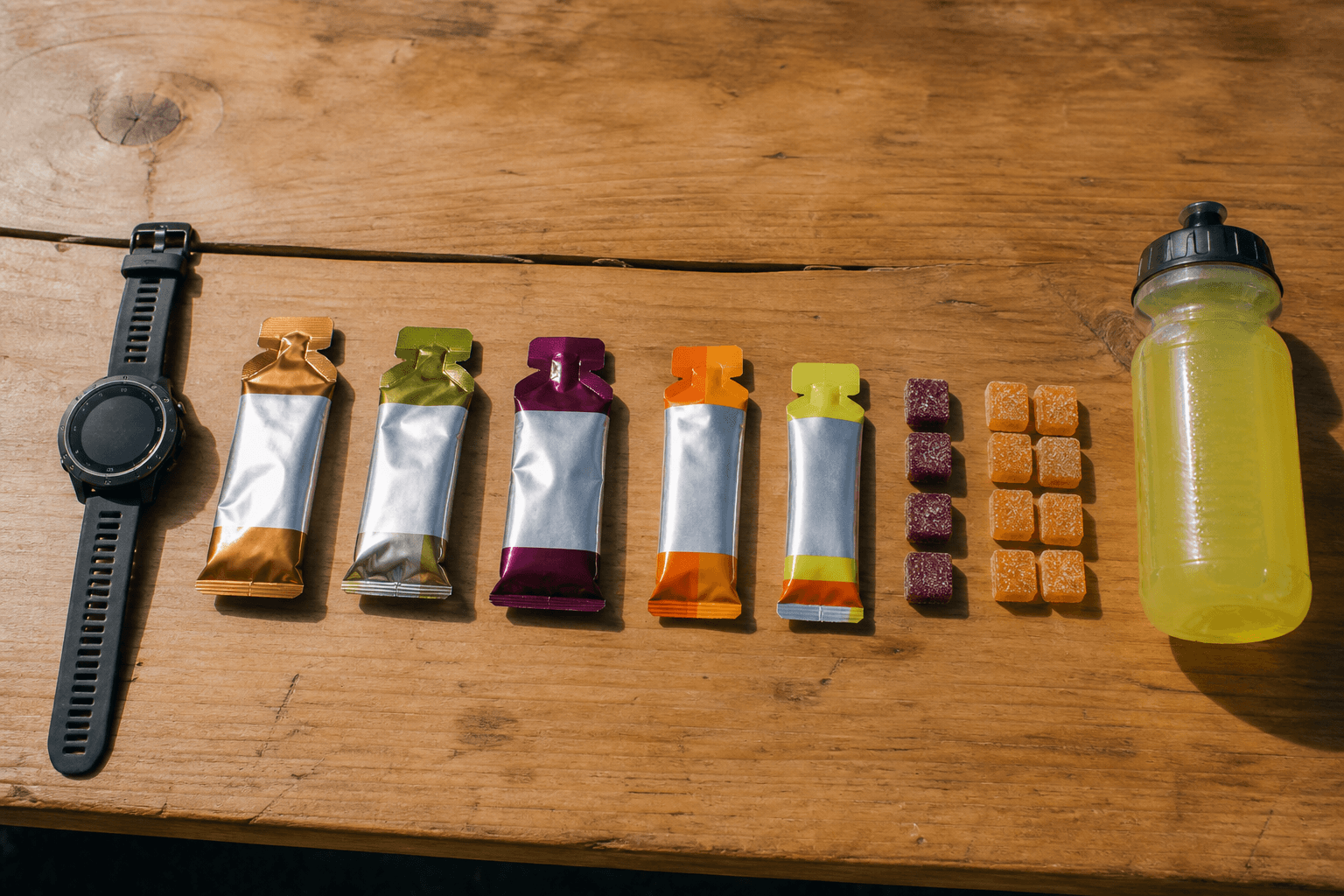
After the gun, being vegan does not change how the gut absorbs glucose and fructose. It changes which packets you can trust. Use 60–90 g of carbohydrate per hour from products whose vegan status you have actually checked, carried in your own belt — aid-station honey gels will not rescue a missed low-fiber carb load.
How many carbs per hour in a vegan marathon?
Jeukendrup (2011, 2014) and the ACSM 2016 stand still set the band: about 30–60 g per hour if you rely on a single carbohydrate source, and up to about 90 g per hour when glucose (or maltodextrin) is combined with fructose.
Most marathoners who have practised land at 60–75 g/h. That is enough to matter in the last 12 km and low enough that the gut usually cooperates if you trained it. 90 g/h is available to runners who have built up to it over weeks. It is not a race-morning upgrade.
Plant-based does not lower the number. It raises the chance you grab the wrong packet. Build the list with the vegan race fuel planner on plantbaes.net; the planner will not recommend products marked not_vegan and hides unclear unless you opt in.
Start fueling by 20–25 minutes, not when the tank feels empty. Absorption lags. Liver glycogen is already dropping in the first half hour.
Why glucose plus fructose changes the ceiling
Glucose crosses the intestinal wall via SGLT1, which saturates somewhere near 60 g per hour. Fructose uses GLUT5, a separate route. Combining the two lets total carbohydrate delivery exceed what either sugar manages alone. That is the physiology behind 90 g/h, not a marketing claim.
A product listing only maltodextrin will not get you to 90 g/h no matter how many packets you open. You will hit the glucose transporter and the extra gel will sit in the stomach. Nausea at 28 km is often that, not “gels in general.”
Maurten Gel 100 is 25 g per packet in a hydrogel. Neversecond C30 and Precision Fuel PF 30 Gel are 30 g. Those grams only stack to 90 g/h if the formula actually includes fructose (or a glucose:fructose mix) and if you have practised the rate. Read the panel. Then run it at long-run intensity, not on an easy recovery jog.
Hour-by-hour vegan fueling for a 4-hour marathon
Template for a runner targeting about 75 g/h over four hours (~300 g total), using manufacturer-confirmed vegan products from the catalog. Adjust flavours to what you have already used. Do not mix in an expo sample.
| Clock | Take | Carbs (g) | Notes |
|---|---|---|---|
| 0:00–0:50 | Sip Maurten Drink Mix 160 from a bottle | 40 | Start sipping in the first 10 min; do not dump the bottle at once |
| 0:25 | Neversecond C30 gel, with water | 30 | First gel before you feel you need it |
| 1:05 | Precision Fuel PF 30 Gel, with water | 30 | PF gels have 0 mg sodium — salt must come from drink or another product |
| 1:35 | Maurten Gel 100, with water | 25 | Keep taking water at the same station |
| 2:05 | Neversecond C30 | 30 | If the gut is calm, stay on schedule |
| 2:35 | Maurten Gel 100 or PF 30 | 25–30 | This is where untrained stomachs start to complain |
| 3:05 | Neversecond C30 Caf or PF 30 Caffeine, if practised | 30 | 75–100 mg caffeine in those SKUs — count it against your total |
| 3:30–finish | Maurten Gel 100 or remaining mix | 25–40 | No new flavour from an aid station |
That pattern is roughly 235–255 g from the listed packets plus the opening bottle, which is why you still need sips of a carbohydrate drink in hours two and three or a second bottle. Count every gram. Two bottles of a 40 g mix is 80 g — most of an hour’s target on its own. Doubling gels on top of that is how people overshoot and feel sick.
Hour 1 is deliberately a little front-loaded. Hours 3–4 are where you protect the gut: same products, water with every gel, caffeine only if it appeared in a long run.
How finish time changes the hourly target
Slower finishers spend more hours running and need more total carbohydrate, usually at a lower hourly rate, because intensity is lower and gut risk from concentrated sugar is higher.
| Finish time | Target rate | Approx. total carbs | Practical pattern |
|---|---|---|---|
| Under 3:00 | 75–90 g/h | 225–270 g | Mostly drink mix plus gels; minimal chewing |
| 3:00–4:00 | 60–75 g/h | 210–300 g | Gel every 25–30 min plus a carbohydrate drink |
| 4:00–5:00 | 50–60 g/h | 250–300 g | Gels and chews, more fluid, more sodium |
| Over 5:00 | 45–60 g/h | 250–330 g | Mixed sources; real food only if practised at this duration |
A 5:15 marathoner who copies a 2:50 fueling plan often fails on volume and concentration, not on “not trying hard enough.” More hours also means more sweat sodium. Skratch Labs Sport Hydration is about 21 g of carbohydrate and 380 mg of sodium per serving and is manufacturer-confirmed vegan. Pair it with gels if you need both fuel and salt.
High-fiber “real food” vs low-residue race fuel
Plant-based runners often try to stay “whole food” on the course. Dates, bananas, homemade rice balls, and chia gels are food. They are also fiber, volume, and fructose at the worst possible time unless you have trained them at marathon intensity.
| What you might grab | Approx. carbs | Fiber / GI risk | Lower-residue swap |
|---|---|---|---|
| 3 Medjool dates | 54 g | ~5 g fiber, high fructose | 2 Neversecond C30 gels (60 g, no fiber) |
| 1 medium banana at mile 18 | 27 g | ~3 g fiber, volume, FODMAP | Maurten Gel 100 (25 g) with water |
| Huma chia gel | ~21 g | Chia adds fiber; texture is a trained taste | Precision Fuel PF 30 if you want 30 g without seeds |
| Trail mix or almonds from a friend | low carb | Fat + fiber, slow emptying | Skratch energy chews (manufacturer-confirmed vegan) |
Huma is manufacturer-confirmed vegan and still a poor default if you have not used chia at race pace. “Natural” is not gentler. de Oliveira and colleagues (2014) put fiber, fat, protein, concentrated carbohydrate, and caffeine on the GI risk list together. A date-and-chia strategy can tick several boxes at once.
If you want chewable carbs, Skratch energy chews (no gelatin, brand vegan statement) or Clif Bloks (ingredient-list verified on common flavors, not Certified Vegan) are the usual trained options. Recheck the flavor you buy.
Which gels and drinks you can actually trust
Brand-level answers fail on this shelf. One manufacturer sells a vegan hydration mix and a dairy recovery mix in the same livery.
From the plantbaes.net catalog (last verified 2026-08):
- Maurten Gel 100, Gel 100 Caf 100, and Drink Mix 160 — manufacturer-confirmed, no animal-derived ingredients stated; not treated here as Certified Vegan.
- Neversecond C30 gel, C30 caffeine gel, C30 drink — manufacturer-confirmed vegan.
- Precision Fuel PF 30 and PF 30 Caffeine gels — manufacturer-confirmed vegan; sodium lives in the hydration line (PH 1500 is 0 g carb, 1500 mg sodium).
- Tailwind Endurance Fuel — manufacturer-confirmed vegan. Tailwind Rebuild is whey. Not vegan.
- Skratch Labs Sport Hydration, Super High-Carb, and energy chews — manufacturer-confirmed vegan. Skratch Recovery contains milk protein. Not vegan.
- GU original Energy Gel — ingredient-list verified on common flavors; the brand does not uniformly label the line vegan. GU Roctane is often unclear because of amino-acid sourcing.
- Honey Stinger — honey. Not vegan.
Statuses are defined on the methodology page. The filterable table is the gels and chews catalog. A brand-by-brand walkthrough is Maurten, GU, and Skratch.
Formulas change. Read the packet you pin to the belt, not a blog post from last year.
Fluid and sodium alongside the carbohydrate
Carbohydrate does not absorb well as a paste. A gel taken with no water sits in the stomach and is a frequent cause of mid-race nausea. Take gels at aid stations so water arrives with them, or carry a bottle.
ACSM fluid guidance still argues against both dehydration and overdrinking. Drink to thirst rather than to a fixed “every mile” rule if you are a slower finisher; overdrinking plain water is how plasma sodium falls. Exercise-associated hyponatremia is more common in that group than in people who sip to thirst.
Practical starting points, then test in long runs:
- Carbohydrate drink at 300–600 mg sodium per litre covers most runners.
- Precision Fuel gels need a separate sodium source.
- LMNT is vegan-stated and 1000 mg sodium with 0 g carbohydrate — pair it with gels; it is not fuel.
- Race-morning loading is a different article: vegan race morning hydration.
Heat, heavy sweat, and a white salt crust on your kit are reasons to raise sodium in training, not reasons to swallow untested salt tablets at kilometer 30.
How to gut-train 60–90 g per hour
Tolerance for 75–90 g of carbohydrate per hour is built over weeks. The gut adapts to both the rate and the specific product. Three long runs is a minimum, not a stretch goal.
- Use the exact products, flavours, and concentrations you will race with.
- Take them at the same clock intervals.
- Raise the hourly rate gradually. Jumping from 40 g/h in training to 90 g/h on Sunday is how people DNF in a toilet queue.
If a product causes trouble twice, replace it. Race day is not the place to find out whether a chew sits well at 30 km.
A simple three-week build for a runner currently comfortable at ~40 g/h:
| Week | Long-run target | What you are teaching the gut |
|---|---|---|
| −3 | 45–50 g/h, race products only | Flavour, texture, and water-with-gel habit |
| −2 | 60–65 g/h at marathon-pace segments | Same clock as race day, including a bottle of mix |
| −1 (taper) | 60–75 g/h for 60–90 min of the shakeout or last long run | Confirm the belt layout; do not jump to 90 g/h here |
Heat raises GI risk even at the same gram rate because splanchnic blood flow is already competing with skin. If your goal marathon is likely to be warm, do at least one of those sessions in similar clothing and fluid access. Concentrated gels without water fail faster when you are already dehydrated.
Practise with breakfast timing as well. The morning meal is race-day breakfast timing; the in-race plan starts when you leave the corral.
How to pack the belt without double-counting
Write the hourly list on paper the night before. Then lay the packets in order. A 4-hour plan at 70 g/h is eight to ten gels if you are not using a drink mix, or five to seven gels plus one or two bottles if you are. Count the bottle. Maurten Drink Mix 160 is 40 g. Two bottles plus six 25 g gels is 40+40+150 = 230 g over four hours — 57 g/h, not 90.
Precision Fuel PF 30 has 0 mg sodium. If every packet in the belt is PF, sodium has to come from PH 1500, from another drink, or from a salty mix such as Skratch Sport Hydration (about 380 mg sodium per serving). Mixing PF gels with a sodium-free bottle of water is a common way to finish crampy and under-salted in heat, even when carbohydrate looked perfect on paper.
Caffeinated and non-caffeinated packets should be physically separated in the belt so you do not take 100 mg at 90 minutes by grab. Maurten Caf 100, Neversecond C30 Caf (75 mg), and PF 30 Caffeine (100 mg) are easy to confuse with the plain versions in gloves.
Carry a spare gel. One packet fails, falls, or tastes wrong. The spare should be a flavour you have used, not an expo mystery.
Caffeine on the course, and what to do when the gut turns
Caffeinated gels typically carry 20–100 mg each. Maurten Gel 100 Caf 100 is 100 mg. Neversecond C30 Caf is 75 mg. Precision Fuel PF 30 Caffeine is 100 mg. If you also drank coffee 45–60 minutes before the start, it is easy to overshoot. Know the milligrams. Details are in coffee before a marathon.
Caffeine increases colonic motility. For some runners that is a bathroom stop, not a kick. If coffee always sends you to a porta-potty, a practised caffeinated gel may still be too much late in the race. Test it.
When it goes wrong:
- Nausea: slow slightly, water without carbohydrate for about ten minutes, then resume at a lower rate. Abandoning fuel usually makes the second half worse.
- Cramp: not reliably a sodium problem. Pace and training load matter more than an emergency salt tab.
- Sudden GI urgency: often race-week fiber still in the pipeline, stacked fructose, or an untested “real food” gel — see preventing runner’s diarrhea.
Do not treat a new aid-station flavour as medicine. Honey Stinger will not settle a vegan stomach. A whey carton will not hydrate you better than water.
| Aid-station offer | Risk | What you should have in the belt |
|---|---|---|
| Honey gel / Honey Stinger | Not vegan; untested fructose-honey mix | Maurten, Neversecond, or PF gel you trained with |
| Whey recovery carton | Tailwind Rebuild / similar dairy | Water + your own mix; save protein for after |
| Banana or orange quarters | Fiber, volume, untested at this intensity | The same gel you took at 1:05 |
| Unknown sports drink in a cup | Unknown carb concentration and vegan status | Your bottle, or water with your gel |
Frequently asked questions
How many carbs per hour should I take during a marathon?
Are vegan energy gels as effective as non-vegan gels?
When should I take my first gel in a marathon?
Which race-day products are not vegan?
Can I use what is handed out on the course?
How much sodium do I need during a marathon?
Should I eat bananas or dates during a vegan marathon?
What if I feel nauseous from gels during the race?
Sources
- Jeukendrup, A. E. (2011). Nutrition for endurance sports: marathon, triathlon, and road cycling. Journal of Sports Sciences.
- Jeukendrup, A. (2014). A step towards personalized sports nutrition: carbohydrate intake during exercise. Sports Medicine.
- Thomas, D. T., Erdman, K. A., & Burke, L. M. (2016). ACSM Joint Position Statement: Nutrition and Athletic Performance.
- de Oliveira, E. P., Burini, R. C., & Jeukendrup, A. (2014). Gastrointestinal complaints during exercise. Sports Medicine.
- Sawka, M. N., et al. (2007). ACSM position stand: Exercise and fluid replacement.
Educational content only. Carbohydrate, fiber, iron, B12, and hydration needs vary. Consult a sports dietitian or physician for individualized guidance — especially if you have a GI condition, anemia, or a history of underfueling.