
Marathon fueling
Gut Training for Plant-Based Runners
Practise 60–90 g of carbohydrate per hour on long runs, then rehearse the race-week fiber drop. Being vegan does not change transporters; it changes residue.
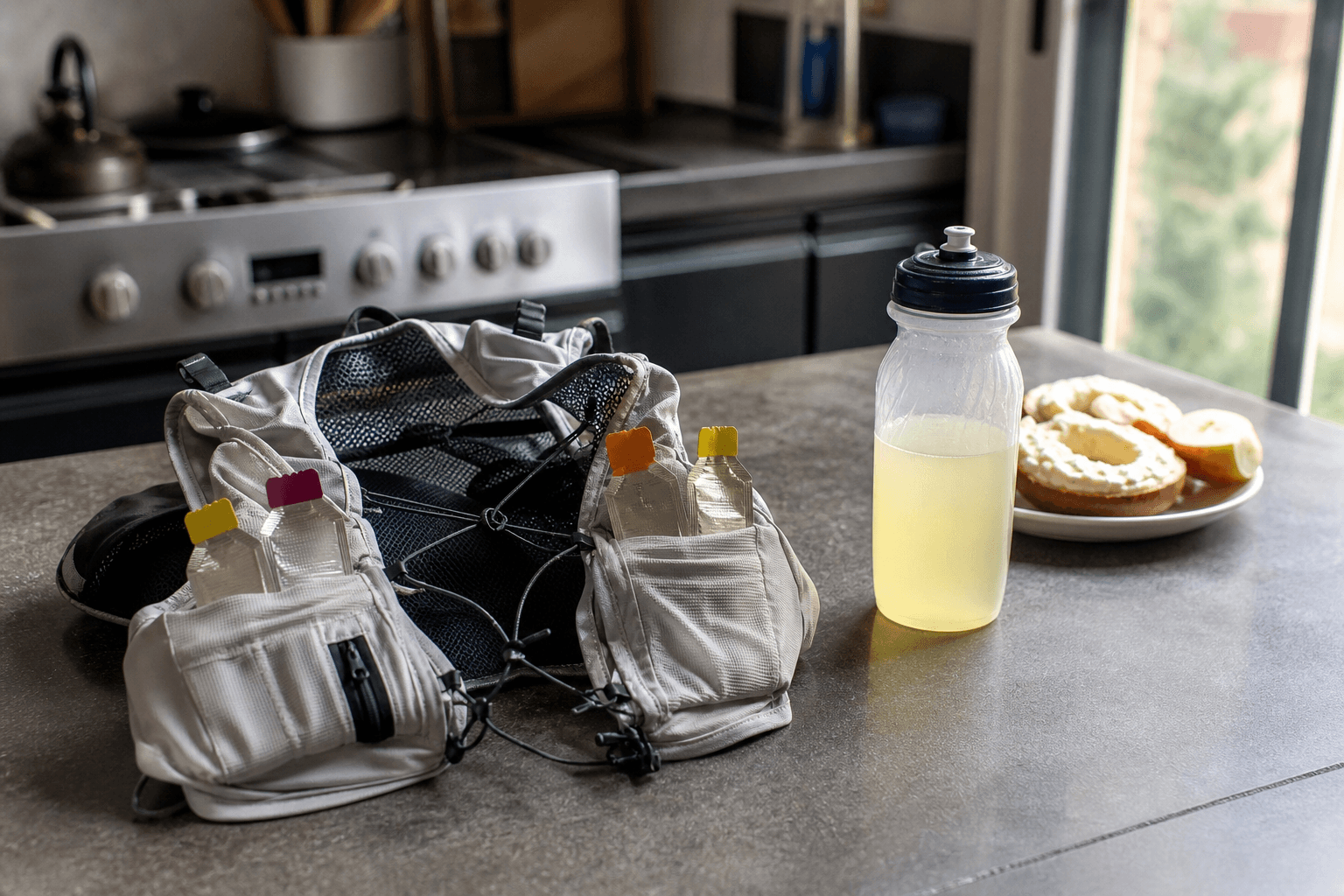
Gut training is practising the rate and the packets you will use on race day so you can absorb more carbohydrate with fewer symptoms. Cox et al. (2010) showed that a period of training with high carbohydrate availability increased exogenous carbohydrate oxidation. Jeukendrup (2017) summarized the same idea as training the gut. Costa et al. (2017) reviewed why the gut fails in the first place: blood flow diverted from the intestine, concentrated carbohydrate, dehydration, heat, and intake you have not practised.
Being vegan does not change SGLT1 or GLUT5. It changes what else is in the gut when you start the long run. A high-fiber plant-based training diet plus 60 g/h of gel is two stressors. You train both, on purpose, on separate weeks — then you combine them before race week.
The two adaptations (do not mix them up)
Established: Repeated intake of carbohydrate during exercise can raise the amount of exogenous carbohydrate you oxidize and can reduce GI symptoms for many athletes (Cox 2010; Jeukendrup 2017). Target band remains about 30–60 g/h, or up to about 90 g/h with glucose plus fructose (Jeukendrup 2014; ACSM 2016).
plantbaes.net addition, heuristic not ACSM: Rehearse a lower-residue breakfast and day-before plate (working ceiling about 15 g of fiber) on at least two key long-run weekends so race week is not the first time lentils disappear. Mechanisms for residue and GI risk: de Oliveira et al. (2014).
| Session type | What you train | What you do not change yet |
|---|---|---|
| Fuelled long run, normal training diet | Hourly grams and product | Keep oats and beans on other meals |
| Race-breakfast long run | Bagel or cream of rice + coffee dose | Can still use a moderate carb rate |
| Combined dress rehearsal (last 3–4 weeks) | Race breakfast + race rate + low-fiber day before | No new gel flavour |
A 6–8 week working block
This is a coaching template, not a trial protocol.
Weeks 1–2. On long runs over ~90 minutes, take 30–45 g/h from the race product family. Start by 20–40 minutes. Water with each packet. Keep your usual plant-based meals the rest of the day.
Weeks 3–4. Raise toward 50–60 g/h on one long run. If nausea or urgency appears, hold the rate and add fluid rather than switching brands. Packet math: how many gels for a marathon.
Weeks 5–6. One long run at race rate (often 60–75 g/h). One weekend copies race breakfast even if dinner is still beans.
Weeks 7–8 (or last two long runs). Full dress rehearsal: night-before plate, low-fiber breakfast, race packets at race rate. Optional: push a 20–30 minute block toward 90 g/h only if glucose-plus-fructose products are already tolerated at 60–75.
Skip the 90 g/h block if you race a half under two hours. 30–60 g/h is enough for most halves.
What to put in the vest while you train
Last verified August 2026. None of these gels is Certified Vegan in this catalog.
| Product | Carbs | Status | Gut-training note |
|---|---|---|---|
| Maurten Gel 100 | 25 g | Manufacturer-confirmed | Glucose + fructose hydrogel. 35 mg sodium — plan salt elsewhere. |
| Neversecond C30 | 30 g | Manufacturer-confirmed | Clean 30 g math. 200 mg sodium. |
| Precision Fuel PF 30 | 30 g | Manufacturer-confirmed | No sodium in the gel. Use their drink if you rely on PF. |
| SiS Beta Fuel Gel | 40 g | Manufacturer-confirmed | Fewer packets; large single hit if untested. |
| Huma chia gel | 21 g | Manufacturer-confirmed | Chia is extra residue. Easy long runs only unless already proven. |
| 3 Medjool dates | 54 g | Food | 5 g fiber. Optional training food, poor default at race rate. |
Honey Stinger is not vegan. Drink mixes (Maurten Drink Mix 160 at 40 g, Tailwind Endurance Fuel at 25 g per labeled serving) count toward the hour. Details: what to eat during a long run.
The fiber-drop rehearsal
A typical oats-legume day often sits above 40 g of fiber. Race week on this site uses a ~15 g working ceiling for the last 36–48 hours. If the first time you eat that way is Thursday of race week, the gut sees a new residue pattern and a new carb rate.
Working rehearsal (one weekend, not every weekend):
- Friday dinner: white pasta, small marinara, tofu or 50 g tempeh — not 1.5 cups chili (~16 g fiber).
- Saturday breakfast before the long run: white bagel, banana, maple (~108 g carbohydrate, 5 g fiber) or cream of rice.
- During: race rate from checked packets.
- After: beans can return at the next meal. You are rehearsing race week, not a new lifestyle.
Check the plate: Fiber Load Checker. Protocol: low-fiber taper week.
When symptoms mean stop climbing the rate
Costa 2017 and de Oliveira 2014 describe a wide range of GI complaints. plantbaes.net working rules:
- Urgency that you can finish with: drop 10 g/h, add water, retry next week.
- Vomiting, blood, fainting, or pain that is not ordinary race stomach: stop the experiment. This article is not clinical care.
- Symptoms only when you stack dates + chia + gel: cut the solids, keep the gel.
- Symptoms only with a new flavour: go back to the practised SKU. Do not use the aid station as a test kitchen.
Diarrhea-specific steps: preventing runner’s diarrhea.
What “trained 90 g/h” actually looks like
Jeukendrup (2014) describes higher exogenous carbohydrate when glucose and fructose are combined. Maurten Gel 100 and Drink Mix 160 use that pair. SiS Beta Fuel Gel is a 40 g glucose-fructose gel. Stacking three different 30 g glucose-only products is not automatically 90 g/h of dual-transporter fuel.
plantbaes.net working rule: do not chase 90 g/h until 60–75 g/h from one product family is boring on long runs. Then add a 20-minute block at the higher rate, then a longer block. If urgency appears, that is data. Drop back. The marathon does not award extra points for 90.
Halves under two hours rarely need this block (vegan half marathon fueling).
Coffee, heat, and fiber are extra stressors
Keep the coffee dose stable while you raise carbohydrate. Do not add a second espresso the same week you add 15 g/h.
Heat plus a new rate is two variables. If you can, raise grams in cool weather first.
Do not gut-train 60 g/h on a chili-and-oat weekend and then blame the gel. Separate the fiber rehearsal from the first rate jump.
Frequently asked questions
What is gut training for runners?
How many grams per hour should I gut-train?
Do vegan runners need a different gut-training plan?
How many weeks of gut training do I need?
Should I gut-train on every easy run?
What if I get diarrhea when I raise the rate?
Do I need to cut fiber for every long run?
Which products should I gut-train with?
Sources
- Cox, G. R., et al. (2010). Daily training with high carbohydrate availability increases exogenous carbohydrate oxidation during endurance cycling. Journal of Applied Physiology.
- Costa, R. J. S., et al. (2017). Systematic review: Exercise-induced gastrointestinal syndrome. Alimentary Pharmacology & Therapeutics.
- Jeukendrup, A. (2017). Training the gut for athletes. Sports Medicine.
- Jeukendrup, A. (2014). A step towards personalized sports nutrition: carbohydrate intake during exercise. Sports Medicine.
- de Oliveira, E. P., Burini, R. C., & Jeukendrup, A. (2014). Gastrointestinal complaints during exercise. Sports Medicine.
- Thomas, D. T., Erdman, K. A., & Burke, L. M. (2016). ACSM Joint Position Statement: Nutrition and Athletic Performance.
Educational content only. Carbohydrate, fiber, iron, B12, and hydration needs vary. Consult a sports dietitian or physician for individualized guidance — especially if you have a GI condition, anemia, or a history of underfueling.